Contents
Why go
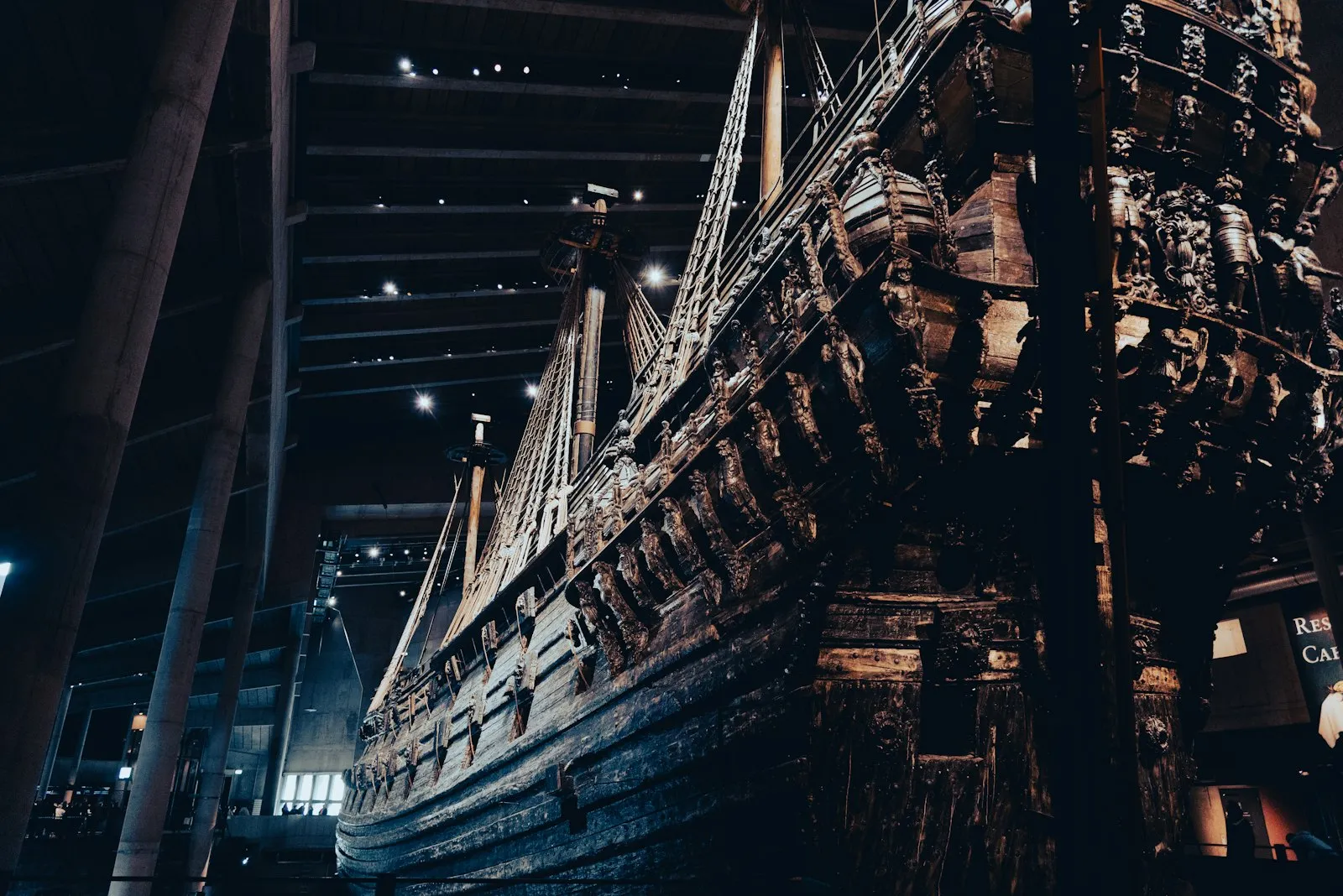
The Vasa Museum holds one ship, and that ship is the reason to come. Vasa was a royal warship built at the Stockholm shipyard, launched in spring 1627 and lost on her maiden voyage the following summer. She lay hidden underwater for 333 years before breaking the surface in 1961, then spent 27 years in a temporary home before she was floated by pontoon into the purpose-built museum that opened in 19902. The museum calls her unique: an intact ship, with over 98%1 of the original structure surviving.
This is not a museum for naval enthusiasts only: a public engineering failure, a sunken time capsule of objects, a salvage that took years, and a conservation job begun in 1962 and not yet finished1. In 2019, its most visited year, it drew over 1.5 million2 visitors. Go in the afternoon if you can: the museum’s own guidance says mornings and lunchtime are usually more busy and afternoons calmer, with queues of up to approximately 30 minutes3 in high season.
What you will see
The ship first. Vasa is 69 metres long and over 50 metres tall to the top of her main mast, weighs more than 1,200 tonnes and carried 64 cannons on 120 tonnes of ballast. On 10 August 1628 she sailed about 1,300 metres, heeled, took water through the open gun ports and went down. The museum’s own account of the inquest says experts believed the ship had too little belly, not enough hull to carry the heavy upper works, and the blame fell on the designer1, Henrik Hybertsson. You can walk around the hull on the different floors4 of the museum, to see the carvings, the gun ports and the gap between what the ship was meant to be and what it was.
The salvage is the second story. Divers recovered cannons as early as 1663 to 1665. The fuels engineer Anders Franzén then located the wreck on 25 August 1956, and it broke the surface on 24 April 1961. Keeping it from cracking as it dried took longer than the salvage itself: spraying with polyethylene glycol began in April 1962 through 500 nozzles, the drying phase ran from 1979 to 1989, and by 2018 conservators had swapped out about 4,000 rusting iron bolts, leaving the ship eight tons1 lighter. The work continues: the hull leans slightly to port and needs a new support structure of 27 cradles5, which the museum calls its biggest challenge since the salvage.
Around the ship sit in-depth exhibitions on life on board, ships in battle, Vasa’s sculptures, the Stockholm shipyard, the salvage and the conservation work. The museum’s own pages disagree on the exact tally: one page counts twelve of these indoors plus the museum garden4 separately outside, while another lists the garden as one of twelve exhibitions in total6. Pick the two or three that match your interest; the ship itself is the exhibit that matters. A 17-minute7 film runs through the day in the ground-floor auditoriums in several languages, which is the quickest way to get the outline before you tour the exhibitions.
Your ticket also covers the temporary exhibition James Cameron: Challenging the Deep, which the museum hosts as its first European venue until September 20278.
The building came out of a 1981 competition that drew 384 designs, won by architects the museum names as Marianne Dahlbäck and Göran Månsson on one page and as the firm Hidemark Månsson Arkitektkontor1 on another; it opened on 15 June 19902.
Visiting: hours, admission, booking
Hours and the adult price change with the season. From 1 May to 30 September an adult ticket costs SEK 240 instead of SEK 195, and anyone 18 or under enters free all year; a young child must be accompanied by an adult throughout the visit, though the museum’s own pages differ on the cut-off, giving 12 and under on one page and younger than 1210 on another. From June to August the museum opens daily 08:30 to 18:00, while the rest of the year it runs 10:00 to 17:00 with a late Wednesday to 20:00. It closes on 24 and 25 December and shortens its hours on 31 December, 10:00 to 15:00; on 1 January it keeps its regular hours, 10:00 to 17:00. The museum takes card payment only9, with no cash accepted.
Tickets are sold online on the museum’s site, but a ticket bought in advance does not give priority10 in the entrance queue. If you also plan to visit Vrak, the Museum of Wrecks, close by at Djurgården9, the combined ticket is valid for 72 hours with one visit to each museum11.
Open guided tours in English are included in admission and last about 25 minutes. From September to May they run once an hour between 10:30 and 15:30; in June, July and August they double to twice an hour from 09:30 to 16:00. The museum’s own pages give two different thresholds for a private tour instead: the tours page says groups of more than nine, its visitor-planning page says groups larger than ten. A private tour costs SEK 1,500 per group on top of admission, booked at least seven days12 ahead. If you would rather go at your own pace, the audio guide streams to your own phone over the free museum wi-fi10 in a long list of languages, from German and Finnish to Arabic, Japanese and Chinese, including a children’s version. Bring your own headphones13.
There are no lockers and large or wheeled bags are not allowed in, so leave luggage at your hotel; a handbag or small rucksack carried on your back or front is fine. The hall is kept at 18 to 20°C10 for the wood, which feels cool after a summer walk, so carry a layer.
Lifts reach every floor, the restaurant and its toilets are wheelchair-accessible, and the information desk lends out two wheelchairs. Film screenings in the main auditorium run with a hearing loop, and assistance dogs are welcome3. Strollers are fine except in the restaurant, and there is a small indoor picnic area10 if you bring food.
Getting there
The museum stands at Galärvarvsvägen 14 on Djurgården. From the city centre, tram 7 runs to the Nordiska museet/Vasamuseet stop; bus 67 stops there too, while buses 69 and 76 stop at Djurgårdsbron, the bridge onto the island. On the metro, ride the red line to Karlaplan and either walk about ten minutes or pick up bus 67 there. For timetables the museum points to SL14; the Stockholm page covers what a day pass costs.
The better route is by water. Ferry 82 from Slussen and ferry 80 from Nybroplan both call at Allmänna gränd on Djurgården, from where the museum is about eight minutes on foot. Walking from the city centre takes about half an hour, or ten minutes by bike. Driving is the weakest option: the car park is small and often full, with two14 accessible spaces by the entrance.
Nearby
Djurgården is Stockholm’s museum island, so plan a full day here. Nordiska museet shares the Nordiska museet/Vasamuseet tram stop14 with Vasa. Skansen, the open-air museum with some 160 historical buildings, opens every day of the year and pairs well with Vasa for anyone travelling with children. ABBA The Museum is a five-minute walk16 away, and the amusement park Gröna Lund, Junibacken’s homage to Astrid Lindgren’s book characters, and the art collections at Waldemarsudde and Thielska Galleriet are all on the same island15.
Vrak, the Museum of Wrecks, close by at Djurgården9, is the natural follow-up if the salvage story caught you. The old town of Gamla Stan rounds off a day with Sweden’s older history.
Frequently asked questions
How long does a visit take? That depends on how many exhibitions you want to read. A sensible core is the 17-minute7 film, the 25-minute12 open guided tour, or the audio guide at about 40 minutes4, plus a walk around the hull; add time for the exhibitions that match your interest.
Is it worth it with children? Yes: admission is free for anyone 18 or under (a young child needs an adult with them: the museum’s pages give the cut-off as 12 and under9 on one page and younger than 12 on another), the audio guide has a children’s version13, strollers are allowed everywhere except the restaurant10, and Skansen, on the same island15, gives children a break from reading labels.
Is the combined Vrak ticket worth it? If the salvage story caught you, yes: it covers one visit to each museum for SEK 359 in high season or SEK 3159 in low season, and it stays valid for 72 hours11, so the two visits do not have to fall on the same day.
What is the best season to visit? Low season, 1 October to 30 April, costs less at SEK 195 and its queues come mainly on weekends and school holidays; high season, 1 May to 30 September, brings the biggest queues3 of the year, though from June to August the doors open daily at 08:30 instead of 10:009.
Are there guided tours? Yes, open English tours are included in admission and run about 25 minutes, once an hour outside summer and twice an hour from June to August; larger groups need to book a private tour instead: more than nine12 on one museum page, larger than ten10 on another.