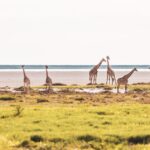
Experience the raw beauty and untamed wilderness of Etosha National Park in Namibia.
“Experience the raw beauty and untamed wilderness of Etosha National Park in Namibia.”
Discovering Namibia’s Etosha National Park: Exploring the Vast Salt Pan and its Diverse Wildlife
Namibia’s Etosha National Park is a vast salt pan that is a premier wildlife destination. It is home to a diverse range of species, including elephants, lions, and rhinos. The park is located in the north-western part of the country, covering an area of 22,270 square kilometers.
Etosha Pan is the centerpiece of this national park. It is an enormous pan that is roughly 130 kilometers long and 50 kilometers wide. The pan is so large that it can be seen from space. During the dry season, the pan is a vast expanse of cracked, white salt, and in the rainy season, it transforms into a shallow lake. This pan is a unique feature of the park, and it supports a wide range of wildlife.
Etosha National Park is home to over 100 mammal species, including four of the Big Five – lions, elephants, leopards, and rhinos. The park also has a wide range of antelopes, such as kudu, impala, and eland. Other species include giraffes, zebras, hyenas, cheetahs, and wild dogs. The park also has over 340 bird species, making it a birdwatcher’s paradise.
The park has a network of roads and waterholes that allow visitors to explore the area and view wildlife. The waterholes are strategically placed around the park, and they attract a wide range of animals. Visitors can park their cars next to the waterholes and watch elephants, lions, and other species come to drink. The best time to view wildlife is early in the morning or late in the afternoon when the animals are most active.
The park has three rest camps, each with its own unique features. The Okaukuejo Rest Camp is located near the park’s southern entrance and has a floodlit waterhole that is popular with visitors. The Halali Rest Camp is located in the central part of the park and has a swimming pool, a restaurant, and a bar. The Namutoni Rest Camp is located in the eastern part of the park and has a fort that was built by the Germans in the early 1900s.
Etosha National Park is a unique destination that offers visitors an opportunity to experience Africa’s wildlife in its natural habitat. The park is not only a wildlife destination but also a cultural destination. The park’s history dates back to the early 1900s when it was used as a hunting ground by the Germans. The park was later designated as a game reserve in 1907 and became a national park in 1967.
The park’s landscape is also unique, with its vast salt pan and surrounding savannah grasslands. The park’s vegetation is adapted to the arid climate, and visitors can see a wide range of plants, such as mopane trees, camelthorn trees, and acacia trees.
Etosha National Park is not only a destination for wildlife enthusiasts, but also for photographers. The park’s unique landscape and wildlife provide endless opportunities for photographers to capture stunning images. The best time to visit the park for photography is during the dry season when the animals congregate around the waterholes.
Visitors to the park can also take part in guided game drives, where they can learn about the park’s wildlife and vegetation from experienced guides. The guided game drives are available at the rest camps and can be booked in advance.
In conclusion, Etosha National Park is a premier wildlife destination that offers visitors an opportunity to experience Africa’s wildlife in its natural habitat. The park’s unique features, such as the vast salt pan and surrounding savannah grasslands, make it a unique destination for wildlife enthusiasts and photographers. With its diverse range of species, including elephants, lions, and rhinos, the park is a must-visit for anyone interested in wildlife.