Why go
Six teak houses, taken apart elsewhere in Thailand and rebuilt as one home beside a Bangkok canal, now hold the art collection of a man who disappeared before he ever explained why he built them. James Thompson was born in Greenville, Delaware, in 1906, served with wartime intelligence in North Africa and Europe, then came to Thailand attached to the Free Thai Movement and stayed on as a military attaché from the spring of 1946. Two years later he put together the money to revive a fading cottage craft: hand-woven Thai silk.
The Thai Silk Company, founded in 1948 and capitalised at US$25,000, turned Thompson into a wealthy man once its fabric dressed the cast of The King and I on Broadway in 1951. He spent part of that money on a house built to show off what the country’s weavers, carvers and painters could do, and today that house is the reason to come: not a recreation, but the rooms he actually lived in, filled with what he actually collected.
What you will see
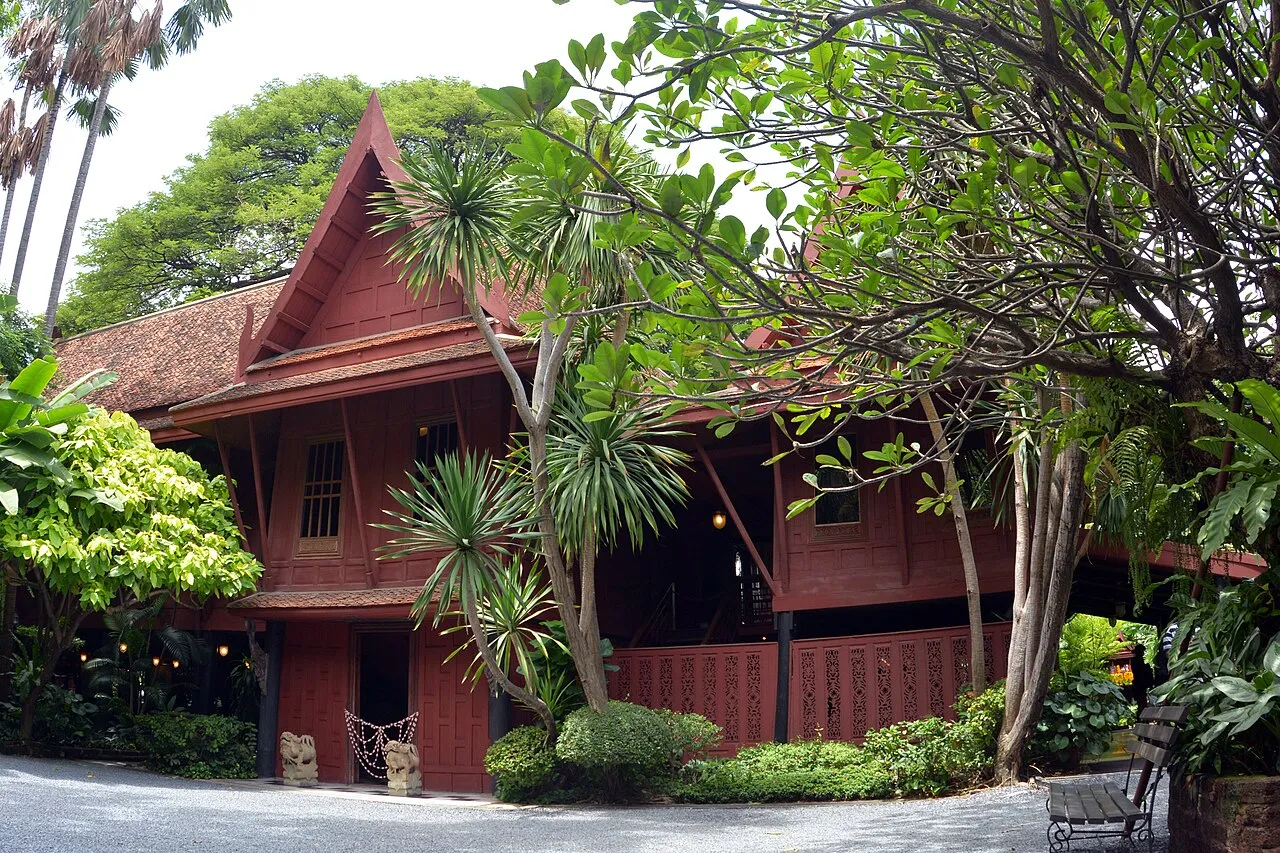
The museum is six traditional Thai houses joined into one, built between 1958 and 1959 on a plot of roughly half an acre. Most of the structures are 19th-century houses moved from Ayutthaya; the largest, a weaver’s house that is now the living room, came from Bangkrua, the silk-weaving district across the khlong. Thompson had the buildings dismantled, moved and reassembled with their outer walls turned inward, so decoration meant to be seen from the street instead faces into the rooms, and the whole complex stands raised on stilts above the garden and the water.
Inside, the rooms hold what he spent two decades collecting: Buddhist statues and Thai paintings on wood, cloth and paper, alongside blue-and-white Chinese porcelain that first reached Thailand from the 16th and 17th centuries onward. A guide leads you through room by room, so you are not left guessing what a piece is or why Thompson placed it where he did.
He never added to that collection past March 1967. On a holiday trip to the Cameron Highlands in Malaysia, Thompson walked out of his rented bungalow and vanished on 26 March 1967; despite searches, no trace of him was ever found, and a Thai court declared him legally dead in 1974. His house and business passed to the foundation that carries his name, under the patronage of Princess Maha Chakri Sirindhorn, and it has run the house as a museum ever since.
Visiting: hours, admission, booking
Hours and the adult ticket price are in the facts box above. What it does not show: you cannot walk through on your own. Entry is by guided tour only, offered in Thai, English, French, Chinese and Japanese, and the last tour of the day leaves at 5pm, the same time the museum closes, so arrive well before then if you also want time in the garden and the shop. The museum sells tickets online through two named ticket partners on its own site; book through one of those rather than an unrelated reseller.
While you are there, the Jim Thompson Art Center shares the same compound, a separate gallery running changing exhibitions of contemporary and traditional Thai art. It is worth the extra half hour if the house leaves you wanting more.
Getting there
The house sits at 6 Soi Kasemsan 2, Rama 1 Road, down a lane off one of central Bangkok’s main roads. The easiest approach is the BTS Skytrain to National Stadium, exit 1, the northernmost station on the Silom line, from where it is a short walk down the soi. Taxis and tuk-tuks also stop right outside; give the driver the Rama 1 Road address rather than just the museum’s name, since that alone is not always enough.
Nearby
National Stadium station also connects by skybridge to MBK Center and the Siam shopping district, so a morning at the house pairs easily with an afternoon among the malls one stop away. For the rest of the city, its neighbourhoods and how to move between them, see the Bangkok city page.