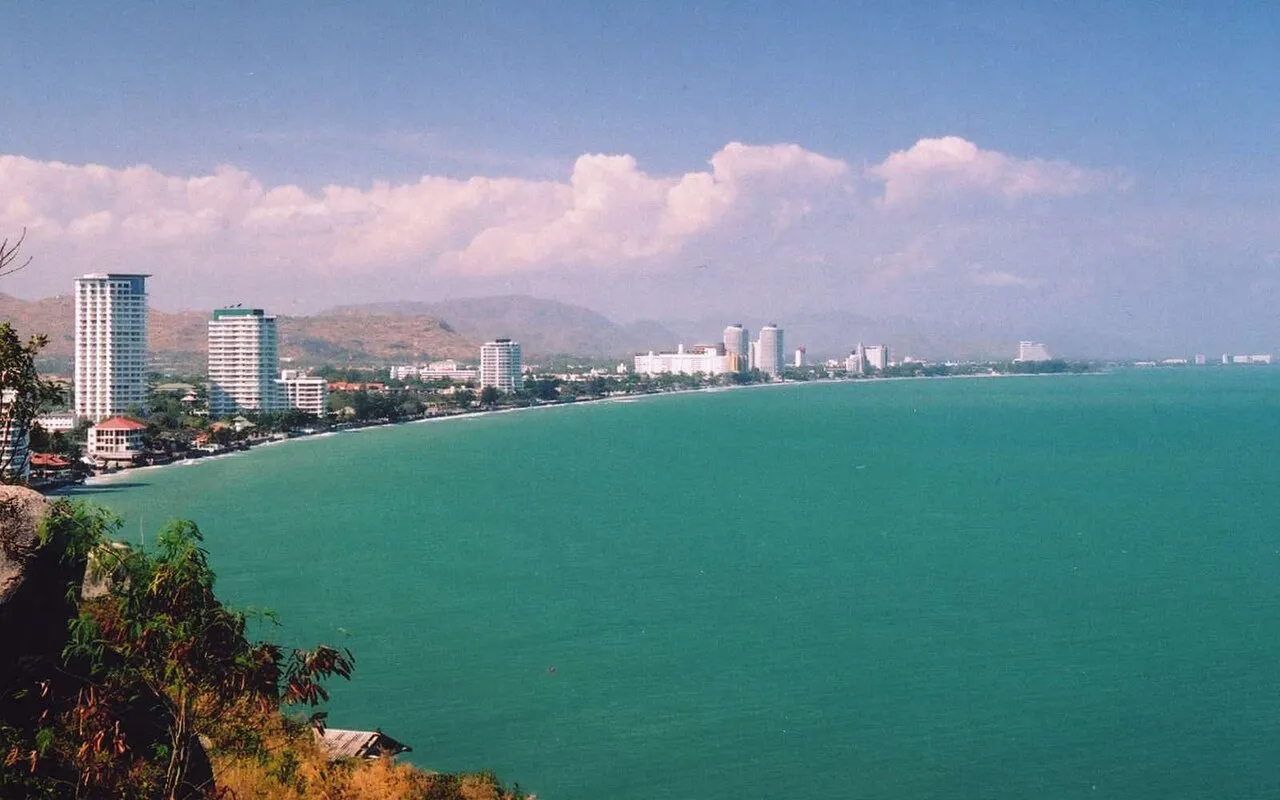
Hua Hin was a fishing village known as Samore Riang until Prince Krom Phra Naresworarit renamed it in the early 1900s, and it became the first and most popular beach resort in the country once the southern railway reached it, with King Prajadhipok building a summer palace there in 1929 that he named Klai Kangwon, “far from worries”. The district was formally split off from Pran Buri and established in its own right in 1949, and today it sits on the Gulf of Thailand roughly 199 km south-southwest of Bangkok, in Prachuap Khiri Khan province. It’s still a royal town at heart: quieter and more upmarket than Pattaya, built around a long sand beach rather than a nightlife strip.
Getting oriented
The old town centres on the railway station and the pier where Hua Hin’s fishing boats still moor, with Phetkasem Road running the length of the built-up area a couple of blocks back from the beach. Most hotels, restaurants and the night market sit within walking distance of this core; the beach itself runs for several kilometres north and south of it, with the hill of Khao Takiab marking where the sand ends at the south end of town.
Highlights
Hua Hin Railway Station
Built in 1910 and rebuilt in 1926 in a red-and-white Victorian style designed by Prince Purachatra Jayakara, this is one of the most photographed stations in Thailand. Its Phramongkutklao royal pavilion was moved here from Sanam Chandra Palace in 1967, and a Baldwin steam locomotive (No. 305, built in 1925) sits on display beside the platform. The station itself was rebuilt again as an elevated line and reopened on 11 December 2023, with the historic building and pavilion kept in place under the Fine Arts Department.
Klai Kangwon Palace
King Prajadhipok’s Spanish-style summer residence, built in 1929, still belongs to the royal family, who customarily spend the hottest months there, which is why its grounds are only open to visitors 09:00 to 16:00 daily for a 20-baht entry fee, and can close without notice when the family is in residence.
Wat Huay Mongkol
West of town toward the Pala-U waterfall, this temple was commissioned by the Queen of Thailand and holds the country’s largest statue of Luang Pu Thuat, a monk famed in his lifetime for his “miracles”. It draws a steady stream of Thai visitors making offerings alongside foreign sightseers.
Khao Takiab
An 8 km hill at the south end of Hua Hin’s beach, topped with Buddhist temples and shrines and a viewpoint over the whole bay, best visited early in the morning before the heat sets in. A local bus runs there from town.
Cicada Market
An open-air weekend market at Khao Takiab, at the south end of Hua Hin, mixing local art, handicraft and food stalls with a small stage for live music — a low-key alternative to the tourist-facing night market downtown.
Getting around
Green songthaews (shared pickup trucks) run the length of Phetkasem Road for a flat 10 baht and are the cheapest way to cover the town. Motorcycles rent for roughly 150–200 baht a day if you want to reach Wat Huay Mongkol or Pala-U on your own schedule, and tuk-tuks and motorcycle taxis cover shorter hops if you negotiate the fare first. From Bangkok, trains run up to 10 times a day and take about 4 hours, while buses from the Southern Bus Terminal cover the same route in roughly 3.5 hours for under 200 baht. Hua Hin’s own airport has limited domestic service, so most visitors still fly into Bangkok and travel overland from there.
Where to stay by area
The old town around the railway station and night market is the budget base, with guesthouses from around 250 to 700 baht a night and everything walkable. The beachfront strip near the Hilton, a short songthaew ride from the centre, has the mid-range and upscale hotels with sea views and pools. Further south past Khao Takiab, resorts thin out and rely more on their own transport, which suits a quieter, longer stay over a short city break.
Day trips
Pala-U waterfall, out past Wat Huay Mongkol toward the Myanmar border, is the classic day trip for hikers, best attempted outside the rainy season when the falls are running but the trails aren’t washed out. Golfers have it easier: at least seven courses lie within a 30-minute drive, including Black Mountain, Banyan and Royal Hua Hin, so a round is a common half-day trip for visitors basing themselves in town for a week or more.