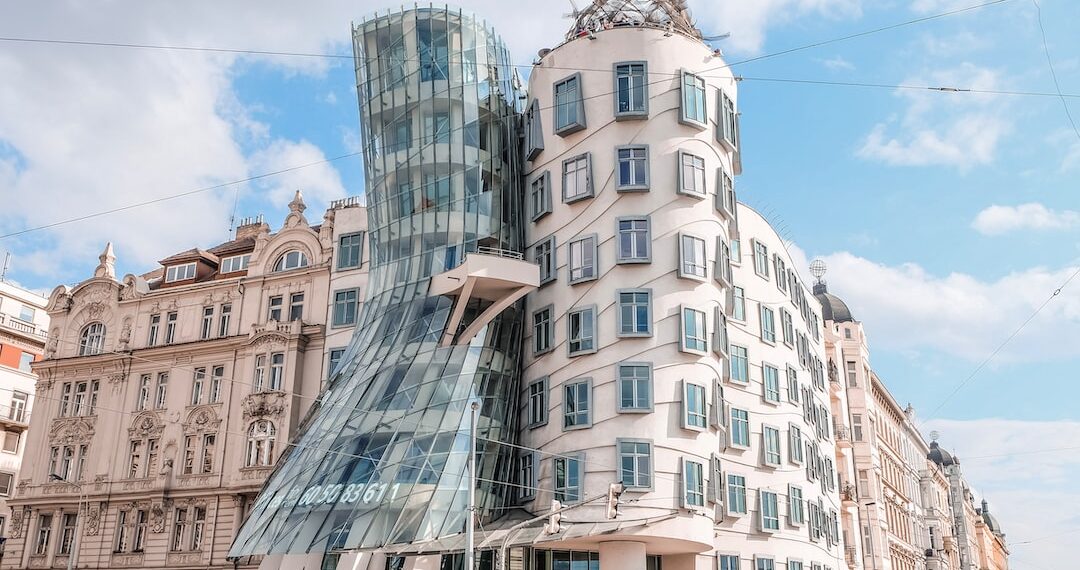
Dancing Through Prague: A Look into Frank Gehry’s Unique Creation – The Dancing House
Prague, the capital city of the Czech Republic, is known for its rich history, stunning architecture, and vibrant culture. One of the most unique and modern buildings in Prague is the Dancing House, also known as the Fred and Ginger Building.
The Dancing House was designed by the renowned architect Frank Gehry and completed in 1996. It is situated on the Rašínovo nábřeží embankment of the river Vltava, in the New Town district of Prague. The building stands out among the traditional Baroque and Gothic buildings that dominate the city’s skyline.
The Dancing House was inspired by the legendary Hollywood dancers Fred Astaire and Ginger Rogers. The building’s design features a dynamic shape that resembles two dancers in motion. The building’s structure is composed of two main parts. The first part is a cylindrical tower, which represents Fred Astaire. The second part is a curvy structure that represents Ginger Rogers. The two structures are connected by a curved glass facade that resembles a dance floor.
The Dancing House’s unique design has attracted a great deal of attention and admiration from both locals and tourists. Many people come to Prague just to see the building and take photos of it. The Dancing House has become one of Prague’s most iconic landmarks and a symbol of the city’s modern identity.
The Dancing House is not just a beautiful building, but it also serves a practical purpose. The building houses several offices, a restaurant, and a rooftop terrace with stunning views of the city. The building’s design allows for maximum natural light to enter the building and provides excellent views of the surrounding area.
The Dancing House’s interior is just as unique as its exterior. The building’s design is characterized by curves and asymmetrical shapes. The walls are covered with white plaster, which contrasts with the steel and glass elements of the building’s facade. The building’s interior is spacious and airy, allowing for a comfortable and pleasant working environment.
The Dancing House is not without its controversies and criticisms. Some people have criticized the building for its modern design, which they say clashes with the traditional architecture of the city. Others have criticized the building’s high cost and the disruption it caused during its construction.
Despite the criticisms, the Dancing House has become an integral part of Prague’s cultural landscape. The building’s unique design and modern aesthetics have inspired other architects to experiment with unconventional shapes and forms. The Dancing House has also become a popular destination for art exhibitions and cultural events.
Prague has always been a city of contrasts. It is a city that seamlessly blends the old with the new. The Dancing House is a perfect example of this contrast. It is a modern building that stands out among the city’s historic architecture, yet it still manages to complement the city’s rich cultural heritage.
The Dancing House is not just a building, but it is also a work of art. It is a testament to the creativity and vision of its designer, Frank Gehry. The building’s design is a reminder that architecture is not just about functionality, but it is also about aesthetics and creativity.
In conclusion, the Dancing House is a unique and modern building that has become an iconic landmark in Prague. Its dynamic shape and asymmetrical design are inspired by the legendary Hollywood dancers Fred Astaire and Ginger Rogers. The building’s design has attracted a great deal of attention and admiration from both locals and tourists. Despite the criticisms and controversies, the Dancing House has become an integral part of Prague’s cultural landscape and a symbol of the city’s modern identity.