Discover the ancient wonders of Luxor Temple in Egypt.
Discovering Luxor Temple: A Tribute to the Theban Triad
Egypt is a land of ancient wonders, where the remains of long-gone civilizations still stand as testaments to the ingenuity and skill of the people who built them. One of the most impressive of these is the Luxor Temple, located in the city of Luxor on the east bank of the Nile River.
The Luxor Temple is a beautifully preserved temple that dates back to the New Kingdom period of ancient Egypt, around 1400 BC. It is dedicated to the Theban Triad of Amun, Mut, and Khonsu, who were among the most important deities in the Egyptian pantheon.
The temple is a popular attraction in Luxor, drawing visitors from all over the world who come to marvel at its stunning architecture and intricate carvings. Its walls are adorned with hieroglyphics and scenes from Egyptian mythology, depicting the gods and goddesses in all their glory.
As visitors approach the temple, they are greeted by a massive entranceway known as the First Pylon. This towering structure is decorated with reliefs depicting the pharaohs making offerings to the gods, and it sets the tone for what lies ahead.
Beyond the First Pylon lies the Great Court, a vast open space that was once used for religious ceremonies and processions. The walls of the court are decorated with scenes of the pharaohs in battle, as well as depictions of the gods and goddesses.
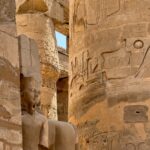
At the far end of the Great Court stands the Hypostyle Hall, a massive hall with 134 towering columns that support the roof. The columns are decorated with intricate carvings and hieroglyphics, and the effect is nothing short of awe-inspiring.
Beyond the Hypostyle Hall lies the Sanctuary, the holiest part of the temple. This is where the statues of the gods and goddesses were kept, and where the priests would perform their rituals. The walls of the Sanctuary are adorned with reliefs depicting the pharaohs and the gods, and the effect is one of profound spirituality.
One of the most striking features of the Luxor Temple is the way in which it blends different styles of architecture. The temple was added to and expanded upon over the course of several centuries, and as a result, it features elements of both the Old Kingdom and the New Kingdom styles.
For example, the First Pylon is reminiscent of the massive stone gateways that were built during the Old Kingdom period, while the Hypostyle Hall is more typical of the New Kingdom style. The blending of these different styles creates a unique and captivating atmosphere that is unlike anything else in the world.
Another interesting aspect of the Luxor Temple is the way in which it has been used over the centuries. After the decline of the ancient Egyptian civilization, the temple fell into disuse and was eventually buried beneath the desert sands.
It was not until the 19th century that the temple was rediscovered and excavated, and since then, it has been used for a variety of purposes. During the 20th century, for example, the temple was used as a military camp and a storage facility for archaeological artifacts.
Today, the Luxor Temple is a popular tourist attraction, and visitors from all over the world come to marvel at its beauty and soak up its ancient atmosphere. Whether you are a history buff or simply someone who appreciates exquisite architecture and stunning art, there is something for everyone at the Luxor Temple.
In conclusion, the Luxor Temple is a true marvel of ancient engineering and artistry, and it stands as a testament to the enduring legacy of the ancient Egyptian civilization. Its towering columns, intricate carvings, and mystical atmosphere are sure to leave a lasting impression on anyone who visits.