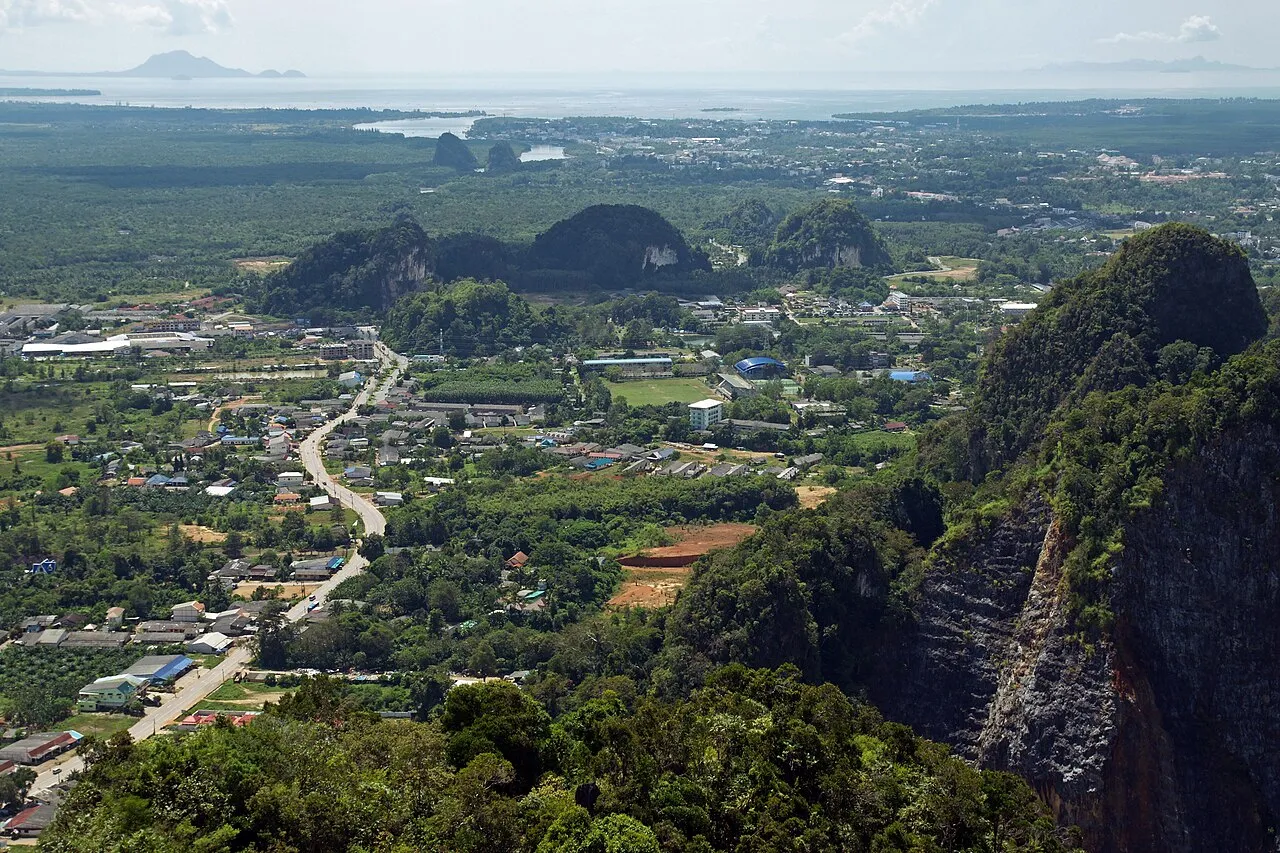
Krabi town sits on Thailand’s Andaman coast, 650 km south of Bangkok, where the Krabi River meets Phang Nga Bay. Limestone karst towers rise straight out of the water and the jungle here, and that geology is the whole reason people come: for rock climbing, for boat trips through more than 80 islands, and for beaches reachable only by sea. Quieter and less built-up than Phuket across the bay, Krabi works better as a base for day trips than as a destination with much to hold you in the town itself.
Getting oriented
Krabi town is a working provincial capital on the river: a night market, a handful of riverside restaurants and a passenger pier, not a resort in its own right. Most visitors pass through it on the way to Ao Nang, the province’s main resort strip a songthaew ride down the coast, where restaurants, dive shops and long-tail boats line the beachfront. Ao Nang counted a population of about 14,400 in 2020 across a roughly 50 km² subdistrict.
Highlights
Railay Beach
Railay, a small peninsula between Krabi town and Ao Nang, is reachable only by boat because towering limestone cliffs cut off the mainland side. Those same cliffs draw climbers from all over the world, and the peninsula splits into four areas: Phra Nang and West Railay, both lined with upmarket resorts, and East Railay and Ton Sai, geared toward climbers and budget travellers. The beach came through the 26 December 2004 tsunami largely undamaged.
Tiger Cave Temple
Wat Tham Suea, the Tiger Cave Temple, sits in the hills north-northeast of town. Reaching the summit shrine means climbing roughly 1,260 steps, some of the risers over 30 cm high, to a golden Buddha statue 278 metres up with a view back over Krabi town and the karst around it — the same view this page’s photograph was taken from. The temple was founded in 1975, when a monk meditating in the cave reported seeing tigers there; a cluster of accessible caves and resident monkeys at ground level give those who skip the climb something to see too.
Getting around
Songthaews are the cheapest way between town and the coast: the white songthaews to Ao Nang leave from the bus terminal and from a stop on Maharaj Road roughly every 10 minutes by day, for 60 baht until 18:00 and 80 baht after. Renting a motorbike costs around 150-200 baht a day and covers ground the songthaew routes don’t. The airport lies about 15 km from the town centre, with air-conditioned buses and songthaews meeting flights. For the islands, ferries leave daily from a passenger pier about 3 km outside town for Ko Phi Phi, Ko Jum and Ko Lanta.
Where to stay by area
Krabi town is the practical, unglamorous base: guesthouses, the night market and easy access to the pier and bus terminal, but no beach of its own. Ao Nang has the beachfront resorts, restaurants and dive shops, and puts you closest to the morning boat departures for day trips. Railay’s West Railay and Phra Nang areas carry the coast’s most expensive beachfront resorts, cut off from a quick trip back to the mainland once the last long-tail boat runs; East Railay and Ton Sai, on the same peninsula, are the budget and climbing-focused alternative.
Day trips
Ko Phi Phi, six islands administratively part of Krabi Province, is reachable by the same ferries that leave from Krabi’s passenger pier. Maya Bay, the cove on Ko Phi Phi Leh made famous by the film The Beach, closed to visitors in June 2018 after receiving up to 5,000 tourists and 200 boats a day, and reopened on 1 January 2022. Ko Phi Phi Don, the largest of the six islands and the only inhabited one, had a population of around 2,500 in 2018 and carries the group’s guesthouses, bars and dive shops.