Why go
Railay sits on a small peninsula between Krabi town and Ao Nang, and the thing that sets it apart is right there on the map: towering limestone cliffs cut the peninsula off from the road network entirely, so the only way in or out is by boat. Locally it’s also written Rai Leh, from the Thai ไร่เลย์, and either spelling gets you the same peninsula. Tourism here goes back to the 1970s, when backpackers and hippies first started visiting the area, long before Krabi’s other beaches had any infrastructure at all. The same cliffs that keep the roads out are what draw climbers here from all over the world, and Railay came through the tsunami of 26 December 2004 largely undamaged, unlike parts of the coast further north.
What you get for the boat trip is a beach split into four distinct pockets, each with its own character, plus a walk to a second beach that most people only reach on foot from here.
What you will see
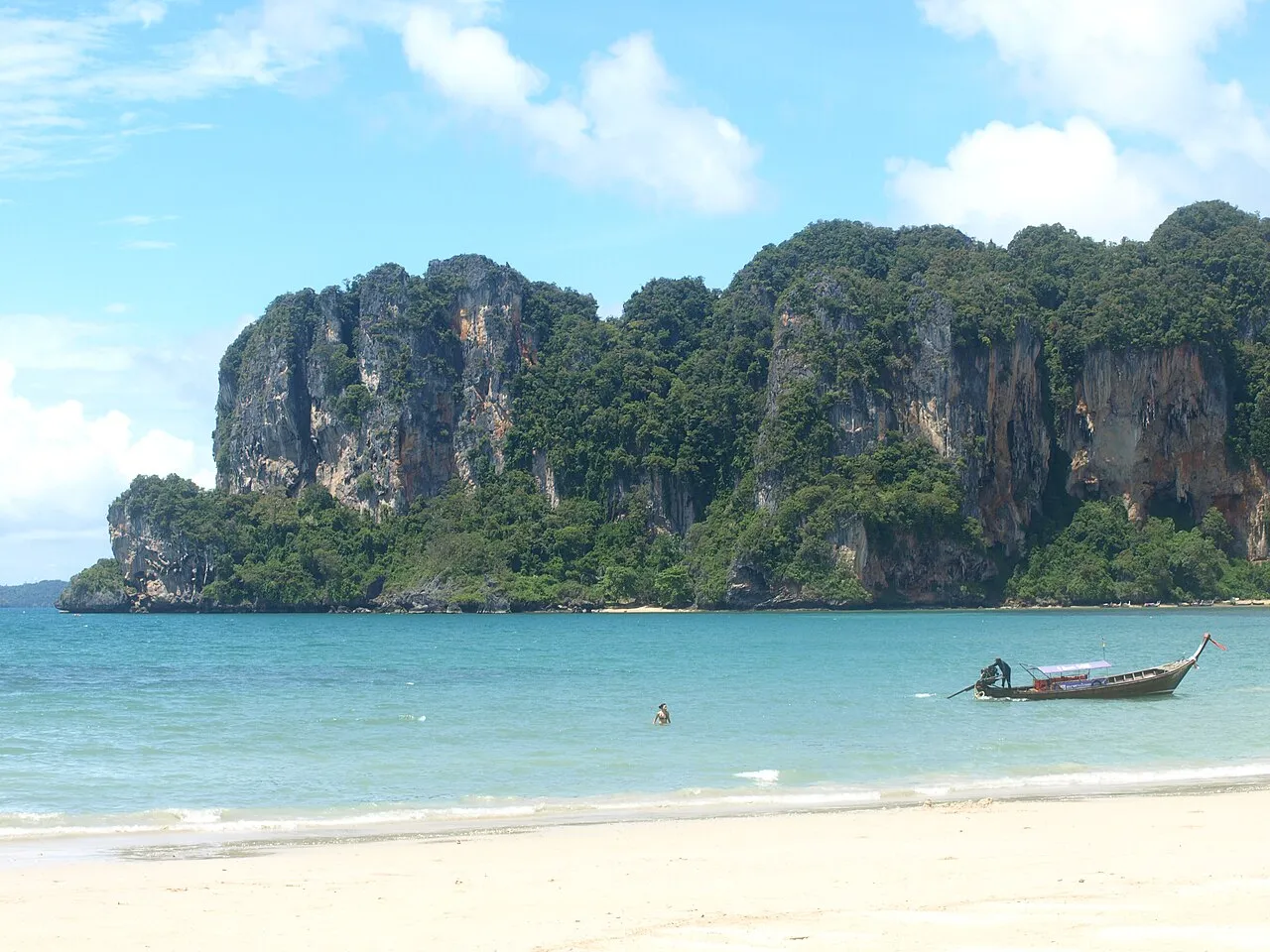
West Railay is the main swimming beach and the one most people picture when they think of Railay: a broad stretch of sand flanked by high limestone cliffs on either side, backed by resorts, with a short promenade of restaurants and shops running along it. Paths and jungle trails connect it to the other side of the peninsula for anyone not staying at one of the beachfront resorts directly. It also doubles as the departure point for long-tail boats and ferries heading on to Ko Phi Phi and Phuket, so if you’re moving further down the coast from here, this is the side you leave from.
East Railay is where the boats from Krabi town dock, and the shoreline there is mostly mangrove, so it’s not a swimming beach. What it does have is a boardwalk lined with restaurants, bars and a Muay Thai school, plus resorts priced lower than West Railay’s — this is the side to check into if you want to be near the action without paying West Railay rates. On the trail up towards Ton Sai, above the boardwalk, Diamond Cave has a walkway built into it, a short detour if you want a break from the beach itself.
Ton Sai, just north of the other two, is the rougher, cheaper option: it caters to climbers and backpackers and feels a good deal more rustic than the resort strip on West Railay or the restaurant boardwalk on East Railay. It’s the base of choice if you’re here mainly to climb, and it’s where you’ll find the largest concentration of climbing schools and gear shops on the peninsula.
The fourth area, Phra Nang, is reached on foot: a public trail winds under overhanging cliffs from the southern end of West Railay’s boardwalk and comes out at Phra Nang Beach, tucked around the point from the rest of the peninsula. It’s the one part of Railay you can’t get to by boat directly, and the walk itself, under the same limestone that shelters the whole peninsula, is as much the point as the beach at the end of it. The cliffs that wrap around Phra Nang are the same ones you’ll see climbers working on routes up from West Railay and Ton Sai — Railay’s whole reputation as a climbing destination comes from this one stretch of limestone wrapping all four beaches together.
Visiting: no gate, no fixed hours
Railay isn’t a ticketed attraction. There’s no entrance gate, no admission fee, and no set opening hours listed on Tourism Thailand’s page for the beach — it’s open coastline, and you come and go on your own schedule, within the limits of the boat timetable and the tide. Rock climbing here is normally arranged through one of the climbing schools based on Ton Sai or East Railay rather than something you book centrally in advance; if you plan to climb, sort a school and route once you’re on the ground rather than assuming you can just show up at a cliff.
Accommodation is the one thing worth booking ahead, especially on West Railay and Phra Nang, since rooms there fill first and cost the most. Ton Sai and East Railay have more flexibility if you’re arriving without a reservation, and generally at lower rates than the resorts facing West Railay’s beach.
Because the whole peninsula sits under the same limestone, the choice of area doubles as a choice of what kind of trip you’re having: West Railay and Phra Nang for beach time near the higher-end resorts, East Railay for budget rooms and the boardwalk scene, Ton Sai for climbing and backpacker prices. None of that is fixed by anything more formal than which stretch of sand you happen to book, so it’s worth deciding what you actually want out of the visit — swimming, climbing or just the boat-only seclusion — before picking where to stay.
Getting there
There’s no road to Railay, so every visit starts on a long-tail boat. From Ao Nang, the crossing is short: about 15 minutes across the bay. Boats from Krabi town run a similar route and dock on the East Railay side, where you’ll find the boardwalk of restaurants and lower-cost resorts on arrival. Long-tail operators run on a “when full” basis rather than a fixed timetable during the day, so you rarely wait long at either departure point, but the last boats stop running in the evening — check the return time before you head out for the day if you’re not staying overnight.
Nearby
Railay is one of the two main reasons people base themselves on this stretch of coast, alongside Krabi’s other limestone attractions and the boat trips out to the islands. For the rest of what to see around Krabi, where to stay in Krabi town or Ao Nang instead, and how the island-hopping trips work, see the Krabi city guide.