Why go
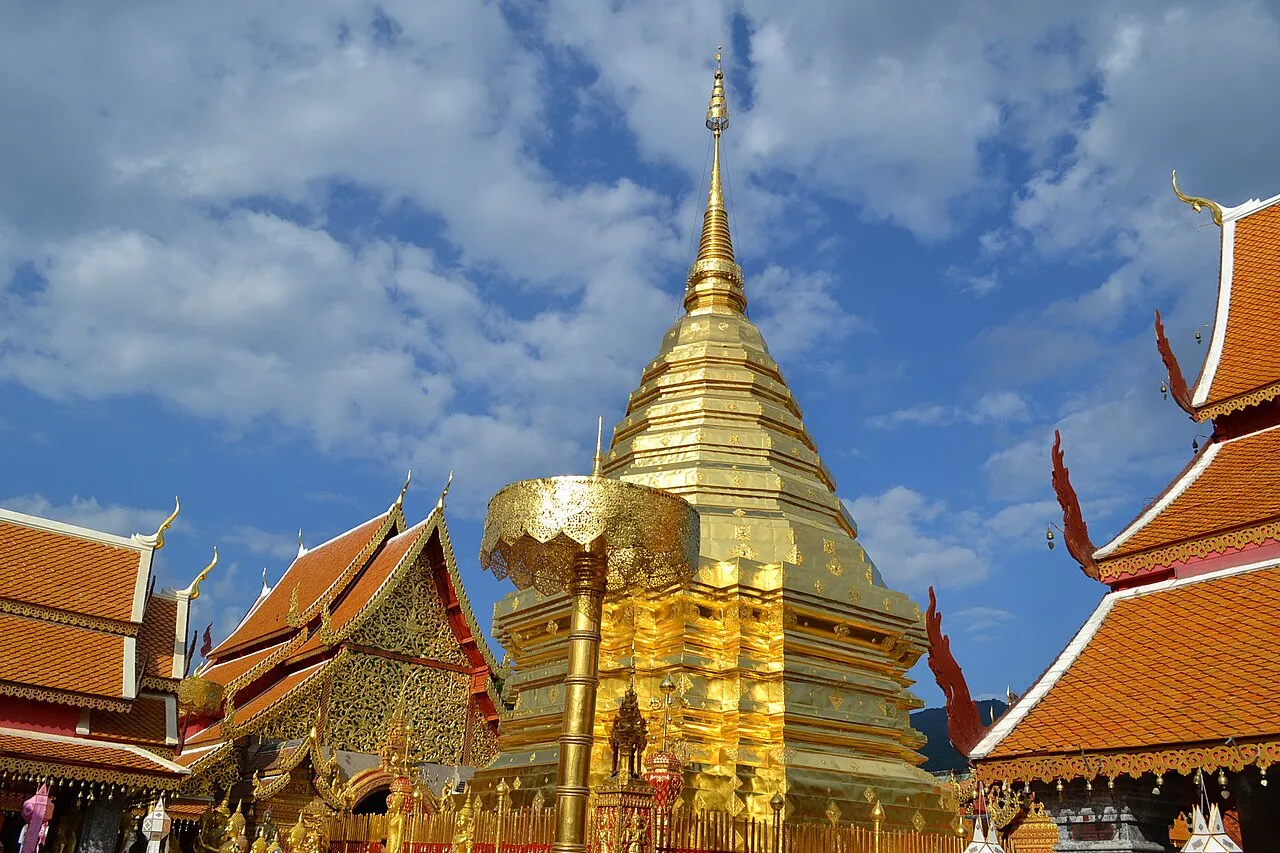
Wat Phra That Doi Suthep is the temple that defines Chiang Mai from a distance: its golden chedi catches the sun on the mountainside above the city, and on a clear day you can pick it out from the old town below. The temple sits about 15 kilometres from the city, 1,050 metres up the slopes of Doi Suthep, and by legend marks the spot where a white elephant carrying a relic of the Buddha climbed the mountain, trumpeted three times and dropped dead, an omen that led King Kue Na of Lan Na to order a temple built there. The relic itself, which many claim is the Buddha’s shoulder bone, was found by the monk Sumanathera and displayed magical powers: it glowed and was able to vanish. The first stupa went up in 13831, and the temple has since expanded, with many more holy shrines added; as of 2026 it is still a working monastery2 and one of the most sacred sites in the region.
The wat can draw 120,000 visitors a month1, with more during holidays such as Songkran and especially Visakha Bucha Day, when local people climb the mountain and sleep on the temple’s esplanade to commemorate the birth of the Buddha.
Doi Suthep works as a half-day trip on its own or as the first stop on the park’s main road2, which also leads to Bhubing Palace and Doi Pui mountain and village, so plan the visit around how much of the mountain you want to see beyond the temple itself.
What you will see
At the centre of the complex stands the chedi itself, a gold-plated stupa about 24 metres tall on an octagonal redented base, its tiered umbrella spire a design that came from two centuries of Burmese occupation. The relic is held in the rounded portion of the chedi1, above the octagonal section and below the ringed one.
Once you are past the top of the stairs, the first thing you see is a white elephant statue commemorating the founding legend. Around the grounds are pagodas, statues, bells, a museum and shrines, drawing on both Buddhism and Hinduism: look for a model of the Emerald Buddha and a statue of the Hindu god Ganesh. Views of Chiang Mai1 open up on the far side of the temple.
Visiting: hours, admission, booking
Thailand’s tourism authority lists the temple as open daily from 05:00 to 21:003, with an entrance fee for foreign adults and free entry for Thai nationals and children of any nationality. The wider Doi Suthep-Pui National Park fee is a separate matter: the park charges it only for camping or visiting major waterfalls. From the car park at the base you can climb 309 steps to the pagodas, lined by the longest Naga balustrade in Thailand, or take the tram2, which has its own fare. The temple is wheelchair accessible1 via a funicular railway and a series of very steep ramps.
Dress modestly: once inside the temple grounds, visitors must be appropriately dressed and must remove their footwear1. No shorts are allowed and shoulders must be covered2, and clothes are available to rent at the entrance for anyone caught out.
Getting there
A road up the mountain was first built in 19351, overseen by the monk Khruba Siwichai. The park is in easy reach of Chiang Mai by car or bike from the west end of the city. Shared songthaews, converted pickup taxis, take less than 40 minutes to reach the temple, though it can be tricky to find a convenient spot in the city to board one. Dress warmly if you go up by bike: the ride can be very chilly2.
You can also walk. The Monk’s Trail starts from a trailhead west of Chiang Mai University and ends at the temple; it takes around 1.5 hours2, passing another temple, Wat Phra Lat, about halfway.
Nearby
Doi Suthep sits inside Doi Suthep–Pui National Park, Thailand’s 24th national park, established in 1981 and covering roughly 257 square kilometres of forest across three peaks, the tallest of which, Doi Pui, reaches 1,685 metres. The park logged around 328,659 visitors in 2019, and it’s noticeably cooler up here than in the city, typically 20 to 23°C, dropping close to 6°C on a cold winter night, so bring a layer even in the tropics. The forest itself shelters nearly 2,000 species of ferns and flowering plants, over 350 reported bird species2 and, for anyone who looks closely at the undergrowth, 561 recorded butterfly species4.
Beyond the temple, the park charges its own fee at its campsites and waterfalls: 100 Baht for a foreign adult, 20 Baht for a Thai adult, at sites open daily from 08:30 to 16:30. The park is also popular for its network of hiking trails and cycling routes, and rare wildlife such as dholes, a rare species of wild dog, have been spotted there2.
With more than a morning to spare, Bhubing Palace, the royal winter residence built in 1961, lies 4 km west of the temple and is open to the public except when the royal family is in residence. The Mon Tha Than Waterfall, nine tiers and often busy, is 3 km into the park, while the ten-tiered Mae Sa Waterfall lies 5 km west of Mae Rim, about 600 metres off highway 1096. At Doi Pui Hmong Tribal Village the 13 km Buddha’s Footprint Trail2 begins; a ranger or a guide is required to walk it.
Most of the park’s trails need a guide because it is easy to get lost, and August and September are the wettest months2, with almost daily rainfall, so plan longer walks for the drier part of the year.
Back in the city, the Chiang Mai page covers the old city’s walled temples, the Nimman café district, and how to get around, all of which pair naturally with a morning spent on the mountain.