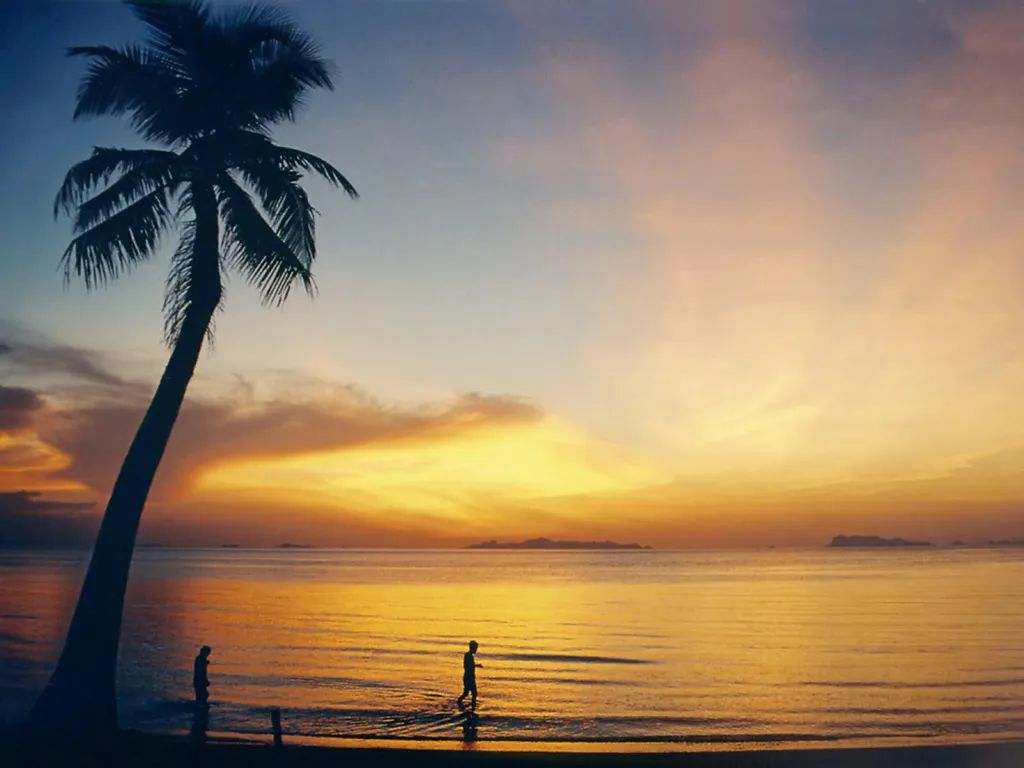
Koh Samui is Thailand’s second-largest island after Phuket, 228.7 square kilometres sitting in the Gulf of Thailand about 35 km northeast of Surat Thani on the mainland. Oral tradition holds that Malay Peninsula fishermen first settled it around the 6th century, though archaeological finds suggest people were here well before that. Tourism stayed modest until Thailand’s national development plans of the 1980s brought investment to the island, and the opening of its own airport in 1989 turned a slow trickle of visitors into the mass tourism the island sees today; Koh Samui became a self-governing city municipality within Surat Thani province in 20121. Unlike Thailand’s Andaman coast, its weather runs on a Gulf-side calendar, covered in the facts box below.
Getting oriented
Nathon, on the west coast facing the mainland, is the island’s official town: government offices and the main car-ferry piers are here, though few visitors linger. The east coast holds the main beach strip, with Chaweng as the busiest base and Lamai just south of it. The north coast is quieter: Bophut, home to Fisherman’s Village, and Maenam beyond it. Bang Rak, at the island’s northeastern tip near the airport, is where you’ll find the Big Buddha.
Highlights
Chaweng Beach
Chaweng is Koh Samui’s largest and most developed beach, a long curve of sand backed by luxury hotels sitting alongside backpacker guesthouses2 and the island’s busiest concentration of restaurants, bars and shops. It’s the obvious first stop if you want swimming, water sports and nightlife within walking distance of where you sleep; quieter beaches are a short ride away in any direction.
Fisherman’s Village, Bophut
On the north coast, Fisherman’s Village keeps more of Koh Samui’s older character: a walkable street of Sino-Portuguese shophouses turned into restaurants, bars and boutiques, with a Friday-evening walking street market that fills the same lane with food stalls and handicraft vendors. Bophut beach itself, right alongside it, is calmer than Chaweng and growing steadily as a base2 without yet matching its scale.
Big Buddha (Wat Phra Yai)
On Ko Phan, a small island joined to Samui’s northeastern tip by a causeway, Wat Phra Yai’s gold-painted seated Buddha stands 12 metres tall and was completed in 1972. It sits 3 km north of the airport3 and is visible from well out at sea, which is why it’s usually the first landmark returning visitors recognise. A short staircase brings you up to the statue’s base and a view back across Bang Rak.
Getting around
Bangkok Airways runs near-hourly flights to and from Bangkok, and the airport sits close enough to Chaweng and Bang Rak that a shared minibus or metered taxi covers the transfer in well under an hour; the fare details are in the facts box. Away from the airport road, shared songthaew pickup trucks run fixed routes at fixed per-person fares before about 18:00, switching to negotiated fares after dark. Renting your own wheels is common: scooters run from around 120–200 baht a day for a small bike, and a small car from roughly 1,200–1,500 baht a day2, useful if you plan to cross the island rather than stay on one beach.
Where to stay by area
Chaweng puts you closest to the nightlife, restaurants and water sports, at the cost of the island’s busiest, priciest strip. Lamai, just south, trades some of that energy for a slightly rougher, beach-bar-and-nightlife scene of its own at lower rates. Bophut and Maenam, on the quieter north coast, suit a slower pace and families, with Fisherman’s Village’s restaurants a short walk or ride away. Nathon, near the ferry piers, is the budget option and the most convenient if you’re arriving or leaving by boat rather than plane.
Day trips
Mu Ko Ang Thong National Park, a cluster of 42 islands about 28 km from Samui, has been protected since 1980 and became a Ramsar wetland site in 2002. Day tours, bookable through operators on Samui, typically combine kayaking and snorkelling around the islands with a climb to the viewpoint on Ko Wua Talap or a look at the saltwater lagoon on Ko Mae Ko; entrance fees are charged on top of whatever tour operators charge for the boat itself4. Back on Samui, Na Muang Waterfall is a lower-effort alternative: a short walk brings you to a fall dropping from around 79 metres2, with pools at the base to cool off in.
_Za3zm0.webp)