Contents
Angolan culture reflects centuries of Portuguese influence1, above all the Portuguese language and the Catholic Church, mixed with a variety of indigenous customs and traditions. When you meet people, you can always use the formal “you”2 and offer to shake hands, and courtesy is judged more by an attitude of respect than by smiling.
Ethnic groups
Angola had 36,604,681 inhabitants at its 2024 census: 29% Ovimbundu, 27% Ambundu, 14% Bakongo and 30% other ethnic groups, including the Chokwe, the Nyaneka-Lumkumbi, the Ovambo, the Ganguela and the Xindonga. The Ambundu and Ovimbundu together form a majority of the population, at 56%. These communities maintain their own cultural traits1, traditions and languages to varying degrees, but in the cities, where slightly more than half of the population lives, a mixed culture has been emerging since colonial times. In that urban culture Portuguese heritage has become more and more dominant, while African roots show in music and dance and shape the way Portuguese is spoken.
The Ovimbundu, whose language is Umbundu, were located in west-central Angola, and most of them remained on the Benguela Plateau above 1,200 metres in elevation. Just north of them lived the Mbundu, whose language was Kimbundu. The Kikongo-speaking Bakongo were concentrated in Uíge, Zaire and Cabinda provinces, and the Angolan city of Mbanza Congo3 was the capital of their ancient kingdom.
Languages
Portuguese is the official language, and the most widely spoken indigenous languages are Umbundu, Kimbundu and Kikongo, in that order. According to the 2024 census, Portuguese is spoken natively by 45.5% of Angolans1, Umbundu by 17.1%, Kimbundu by 10.8%, and Chokwe and Kikongo by 6.9% each. Although Portuguese is the official language, for many black Angolans it is a second or even third language3.
Religion and the Kingdom of Kongo
In 2024, 79.1% of Angolans were Christian, 44.2% Catholic and 34.9% Protestant, while 11.5% had no religion. The Catholic Church and some major Protestant denominations mostly keep to themselves, in contrast to the “New Churches”, which actively proselytize1; Catholics and some major Protestant denominations provide help for the poor in the form of crop seeds, farm animals, medical care and education.
Mbanza Kongo, on a plateau at 570 m, was the political and spiritual capital of the Kingdom of Kongo, one of the largest constituted states in Southern Africa from the 14th to the 19th century. After the arrival of the Portuguese, the kingdom adopted Christianity while retaining elements of pre-existing Kongo customs, and its capital has retained the ritual and symbolic powers embodied in the brotherhood of the Leopard Ngo. The cathedral was standing when, in 16084, the Pope accredited in Rome the first ambassador of a sub-Saharan African state to the Vatican.
Sona sand drawings
Sona, drawings and geometric figures on sand, was inscribed in 2023 on UNESCO’s Representative List of the Intangible Cultural Heritage of Humanity. It is practised by the Lunda Cokwe and neighbouring peoples in eastern Angola as a form of expression that seeks to convey beliefs, thoughts and emotions, and the relationship between human beings and nature. Practitioners mark reference points on a wet floor covered in sand using their index finger and pinkie5, then trace lines around these points. The figures are a means of transmitting stories, knowledge and collective memory to new generations, and Sona is passed on during initiation rites for youth who are preparing to assume social functions; it is also practised as a decorative art.
Music and dance
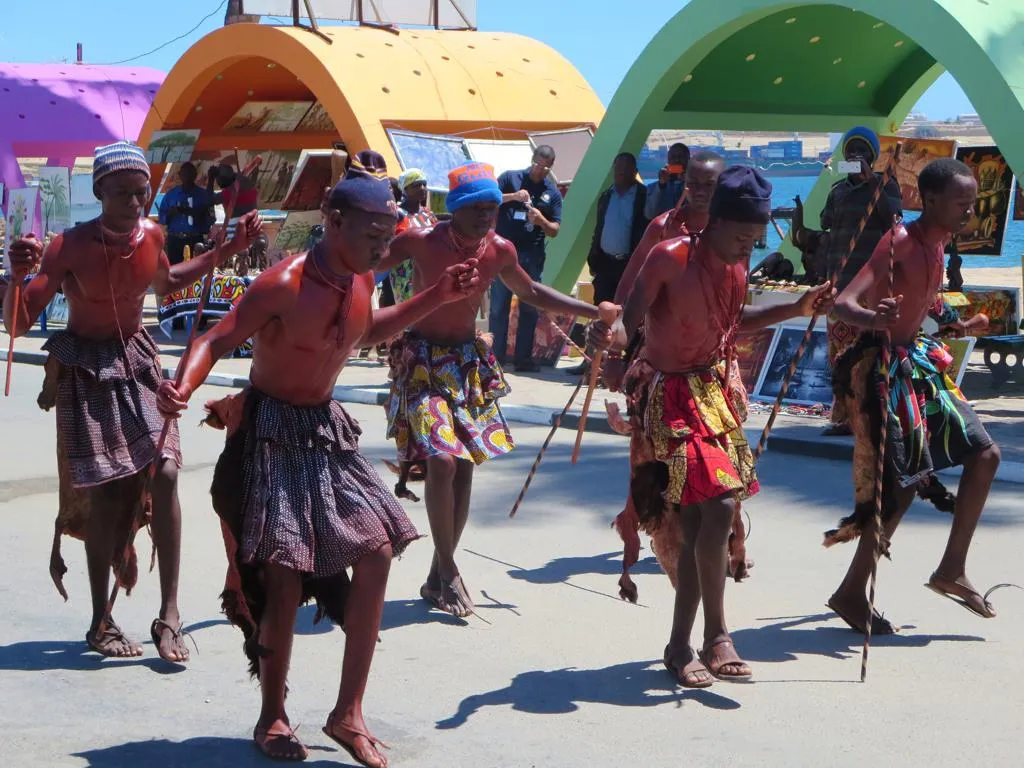
Semba is a traditional type of music and dance6 from Angola, and its subject matter is often a cautionary tale or story about day-to-day life and social events, usually sung in a witty rhetoric. It is present at funerals as well as at many Angolan parties. Kizomba is a social dance and music genre that originated in Angola during the late 1970s to early 1980s7, and its name means “party” in Kimbundu. It has a slower, more romantic rhythm than semba; traditionally it was danced with family and friends at parties and weddings, and it is also enjoyed in clubs and at Kizomba Na Rua (kizomba on the street), which is popular in Luanda. Carnival is a public holiday, falling on 16 February in 20268.
Greetings and etiquette
It is common for women to greet both men and women with two kisses, and one kiss for very close friends. Men generally shake hands, and in a business situation handshakes are more common. When you are introduced to an elder you must use the formal “you”, and if the older person is a woman, it is a sign of great respect to incline slightly forward and clasp her hand in both of yours. When you are formally introduced to a man, the most courteous greeting is a firm handshake while you look him straight in the face. Angolans do not smile excessively, and when addressing an elder you should always use “Mr.” or “Mrs.” with the person’s first name. At a social gathering you can greet either each person or the group as a whole, depending on the host’s style; if in doubt2, use the more formal greeting or farewell.
Photography and public affection
Do not use cameras, binoculars or GPS equipment near any government buildings; taking photographs in the streets can draw the attention of the authorities, who may confiscate your camera. The UK advice is also not to attempt to watch or photograph any demonstration or disturbance. In January 2019, Angola’s parliament made it illegal to discriminate against people on the basis of sexual orientation, but public attitudes towards same-sex relationships are less tolerant than in the UK9, and showing affection in public may attract negative attention.
Practical tips
- Use the formal “you”2 with strangers and elders, and offer to shake hands.
- Address an elder as “Mr.” or “Mrs.” with their first name2.
- Keep your camera away from government buildings; street photos can also draw the attention of the authorities9.
- To see Sona, look to the Lunda Cokwe areas of eastern Angola5, where it is practised.
What to check before you go
- The date of this year’s Carnival holiday, if you want to plan a trip around it.
- The current UK travel advice9 for photography rules and the local laws that sit alongside these customs.
- The Angola country guide and the costs guide for planning the rest of the trip.