Angola is a country on the western coast of Southern Africa, and at 1,246,700 km² it is the world’s twenty-second largest country, about twice the size of France. Its province of Cabinda is an exclave on the Atlantic coast, bordering the Republic of the Congo and the Democratic Republic of the Congo1. This is a trip that takes planning: roads outside Luanda and the provincial capitals are often in poor condition2, and outside major urban centres foreign visitors usually travel in convoys of at least 2 vehicles.
Regions and main cities
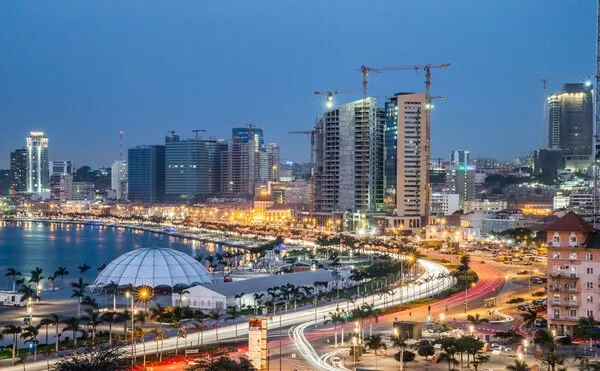
Luanda is the capital and most populous city1.
Mbanza Kongo, the capital of Zaire Province3, stands on a plateau at an altitude of 570 m. It was the political and spiritual capital of the Kingdom of Kongo, one of the largest constituted states in Southern Africa from the 14th to 19th centuries4. UNESCO lists one World Heritage Site for Angola, Mbanza Kongo, Vestiges of the Capital of the former Kingdom of Kongo, inscribed in 20175.
In Malanje Province, the Kalandula Falls on the Lucala River are 105 metres high and 400 metres wide, and they are one of the largest waterfalls by volume in Africa. The distance from Luanda is 360 km6.
Quiçama National Park, also spelled Kissama, is in northwestern Angola, approximately 70 km from Luanda7.
Iona National Park8 is the largest and oldest national park in Angola. It is in the southwestern corner of the country, in Namibe Province, roughly bound by the Atlantic Ocean to the west.
Getting there and around
Luanda’s Dr. António Agostinho Neto International Airport was officially inaugurated on 10 November 2023, and in March 2026 the transfer of scheduled passenger airline operations from the old Quatro de Fevereiro International Airport was completed. It is 40 km south-east of Luanda city centre9.
Your passport must have an expiry date at least 6 months after the date you arrive and at least 2 blank pages. There is a risk of yellow fever transmission in Angola, so you will need a yellow fever vaccination certificate10 for some onward travel, including to South Africa.
You can drive on a UK photocard licence for up to 30 days, and you show your licence, permit, ownership and insurance documents at the frequent police checkpoints. UK advice in 2026 says landmines and unexploded bombs and weapons are still a problem on roads, verges and bridges, and that even in cleared areas you should keep to well-established routes. It recommends against using taxi apps2 where possible.
The Benguela Railway, opened in 190511, terminates at the port of Lobito on the Atlantic coast, and the section from Lobito to Luau is run by the Empresa do Caminho de Ferro de Benguela.
When to go
Angola has distinct, alternating rainy and dry seasons. In the north, the rainy season may last for as long as seven months, usually from September to April1. In the south it begins later, in November, and lasts until about February. The dry season, cacimbo, is often characterised by a heavy morning mist.
During the rainy season from November to April there are storms and heavy downpours, which can cause sudden, serious flooding in and around cities, including Luanda. In the same months there is an increased chance of mines shifting2 due to flooding outside known mine fields.
Money, safety and visas
You must declare cash or travellers cheques worth 5,000 US dollars or more, and you cannot take out more than that in foreign currency. You can take out up to 50,000 kwanzas10 in cash on top. Be careful when withdrawing money from banks and ATMs, as you could be followed and robbed2.
UK advice, still current in November 202612, is against all but essential travel to Cabinda Province, except Cabinda city, because separatist groups carry out targeted attacks on foreigners and there is a risk of kidnap. It also covers the strip within 1 km of the DRC border in Lunda Norte province, except for official border crossings and their access roads. The Dutch government’s 2026 advice is code orange13 for Cabinda and the Lunda Norte border area, and code yellow for the rest of Angola. There is a high level of crime in Luanda2, some of it violent, and the UK advises against walking around the city, especially alone or after dark. Yellow fever, malaria and dengue, Zika virus and cholera are among the health risks14 the UK lists.
With a British passport you do not need a visa to visit for up to 30 days for tourism, and the Dutch government gives the same 30-day limit13 for Dutch passports. Work, study or business trips need a visa in advance, and an overstay can cost 15,000 kwanzas a day10.