Contents
For most trips, the best time to visit Angola is the dry, cool season, which runs from June to late September. The rainy, hot season1 takes up the rest of the year, from October to April or May. For the country as a whole, the best period runs from mid-May to August2, the coolest and sunniest time, at least in inland areas, while fogs and low clouds are frequent along the coast.
Dry season and rainy season
Like the rest of tropical Africa, Angola has distinct, alternating rainy and dry seasons. The dry season, cacimbo, is often characterised by a heavy morning mist3.
Rain within the wet season does not arrive evenly. In northern Angola it has two maxima, in November-December and March-April2. The coolest months are July and August3, in the middle of the dry season, when frost may sometimes form at higher altitudes.
North, plateau, coast and south
Angola’s climate varies considerably from the coast to the central plateau and even between the north coast and the south coast. The north, from Cabinda to Ambriz, has a damp, tropical climate1, while the southern strip between the plateau and the frontier with Namibia has a desert climate.
The length of the rainy season depends on where you are. It runs from mid-September to April in the north-east2, from mid-October to April in the centre and from November to March in the south, while along the coast at Luanda it only lasts from February to April.
Altitude counts too: temperatures fall with distance from the equator and with altitude, so Soyo, at the mouth of the Congo River, averages about 26 °C a year. Huambo, in the centre of the plateau, lies at 1,700 metres (5,600 feet)2 above sea level. Precipitation is generally higher in the north, but at any latitude it is greater in the interior than along the coast3 and increases with altitude. Annual rainfall is only 5 cm (2 in) at Namibe and 34 cm (13 in) at Luanda1, and as high as 150 cm (59 in) in the northeast.
On the plateau, the coolest season brings wide variations in temperature between night and day2, so nights are cold, sometimes close to freezing, while during the day it can even get hot.
Luanda
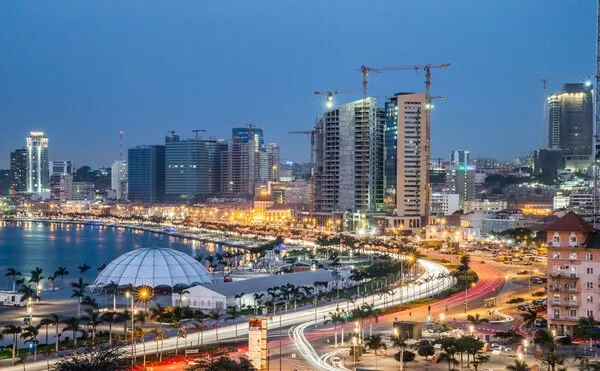
Luanda has a hot semi-desert climate, dry owing to the cool Benguela Current, and the same current gives the city a surprisingly low humidity4 despite its tropical latitude. Although there is little rain, fog, mists and low clouds2 are common from July to October in Luanda.
In INAMET records for 1961 to 2000, March and April brought 57.1% of all precipitation in Luanda, January to April 76.8%, and May to October only 4.5%, with June and July at 0.0%. Between 1911 and 2005, Luanda’s average air temperature rose by about 0.2°C per decade, or 1.9°C between 1911-20 and 2001-055.
Storms and flooding
The UK government warns that during the rainy season from November to April there are storms and heavy downpours, which can cause sudden, serious flooding in and around cities, including Luanda. Flooding can damage roads, buildings and bridges6, and its advice is to stay indoors during storms.
Practical tips
- Aim for the dry, cool season from June to September, especially for an overland trip outside Luanda.
- For a beach stay in Luanda, December to June2 works, though you might avoid March and April, the only relatively rainy months.
- On the south-central plateau in June to August, pack a sweater, a jacket and a hat2 for the evening.
- In the wet season, leave slack in an overland itinerary in case flooded roads or bridges slow you down.
What to check before you go
- The current UK, Dutch and US travel advisories, including the UK government’s flooding guidance6 for the rainy season.
- Local weather forecasts and storm warnings for the cities on your route if you travel between October and May.
- Road conditions for any long drive, since the UK government says infrastructure outside major urban centres may be poor6.