Discover Casablanca’s Hassan II Mosque: An Architectural Masterpiece Uniting Tradition and Innovation.
“Discover Casablanca’s Hassan II Mosque: An Architectural Masterpiece Uniting Tradition and Innovation.”
Morocco’s Marvel: Exploring the Architectural Masterpiece of Casablanca’s Hassan II Mosque
Morocco, a North African country with a rich culture, diverse landscapes, and a vibrant history, is home to many architectural wonders. Among its most famous cities is Casablanca, a bustling metropolis that perfectly blends the old and the new, with its traditional markets and modern skyscrapers. One of the city’s most iconic landmarks is the Hassan II Mosque, an architectural masterpiece that stands as one of the largest mosques in the world. Featuring a retractable roof and intricate tile work, it is a testament to the country’s deeply rooted Islamic heritage and its dedication to preserving it for future generations.
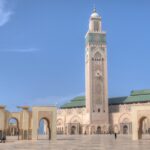
Located on the Atlantic coast of Morocco, the Hassan II Mosque was built to commemorate the 60th birthday of the former king, Hassan II, and was designed by Michel Pinseau, a renowned French architect. Constructed between 1986 and 1993, the mosque is an incredible feat of engineering, combining traditional Moroccan design with modern technology. Spread across nine hectares of land, the mosque can accommodate up to 105,000 worshippers at once – 25,000 inside the prayer hall and another 80,000 in the courtyards and squares surrounding the building. The mosque’s minaret, at 210 meters (689 feet) high, is the tallest in the world and serves as a symbol of Casablanca’s skyline.
One of the most striking features of the Hassan II Mosque is its location. Built on a promontory that juts out into the Atlantic Ocean, the mosque seems to rise out of the water itself. This setting was chosen purposefully, as it was inspired by a verse from the Quran that states, “The throne of God was built on water.” The mosque’s foundation is supported by thousands of concrete piles driven deep into the ocean floor, ensuring its stability and longevity. The result is a breathtaking view of the mosque and the surrounding ocean, creating a tranquil atmosphere that invites visitors and worshippers alike to reflect and find peace.
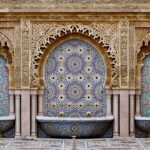
As you approach the mosque, you can’t help but be captivated by the intricate and colorful tile work that adorns the exterior walls. This traditional Moroccan art form, known as zellij, is a hallmark of Islamic architecture and is characterized by geometric patterns made from small, hand-cut glazed tiles. The Hassan II Mosque features over 50,000 square meters (538,000 square feet) of zellij, with more than 80 different patterns that showcase the incredible skill of the Moroccan artisans who created them. The tiles, in shades of blue, green, and white, are arranged in complex symmetrical designs that reflect the beauty and harmony of Islamic art.
As you step inside the mosque, the grandeur of the interior is immediately apparent. The prayer hall, which covers an area of 22,000 square meters (237,000 square feet), is a masterpiece of craftsmanship and design. The floor is covered in hand-knotted wool carpets, while the walls and columns are adorned with intricately carved plaster and cedar wood. The ceilings, reaching heights of up to 65 meters (213 feet), are covered in elaborate muqarnas – a form of Islamic architectural ornamentation that resembles stalactites – and are painted in vibrant hues of gold, blue, and green.
The retractable roof is another standout feature of the Hassan II Mosque. Spanning 3,400 square meters (36,600 square feet), the roof is designed to open in just under five minutes, allowing natural light and fresh air to fill the prayer hall. This innovative feature not only enhances the spiritual experience for worshippers but also showcases the mosque’s commitment to blending traditional and modern architectural elements. The retractable roof is adorned with intricate patterns and designs that echo the motifs found throughout the rest of the mosque.
The mosque’s lighting system is another marvel of modern technology, as it is designed to respond to the natural light conditions of the day. During daylight hours, the mosque’s exterior is illuminated by sunlight, which filters through the stained glass windows and reflects off the zellij tiles. As evening approaches, the mosque’s lighting system gradually intensifies, creating a soft, warm glow that highlights the intricate patterns and designs on the building’s exterior. This dynamic lighting system not only enhances the beauty of the mosque but also serves as a reminder of the passage of time and the importance of daily prayer in Islamic tradition.
The Hassan II Mosque also houses a number of other facilities, reflecting its role as a center for religious, cultural, and educational activities. Within the complex, you’ll find a library, a museum, a Quranic school, and even a hammam, or traditional bathhouse. These additional facilities highlight the importance of the mosque as a community space, where people can come together to learn, worship, and strengthen their faith.
The Hassan II Mosque is not only an architectural masterpiece but also a symbol of Morocco’s dedication to preserving its rich Islamic heritage. As one of the largest mosques in the world, it stands as a testament to the incredible skill and craftsmanship of the Moroccan artisans who brought it to life. With its breathtaking location on the Atlantic coast, its intricate tile work, and its state-of-the-art retractable roof, the Hassan II Mosque is a must-see destination for anyone visiting Casablanca, offering a unique insight into the beauty and complexity of Moroccan culture.