Why go
Abuko is one of the oldest established reserves in the Gambia, and Access Gambia calls it the Gambia’s first reserve2. An evergreen forest gallery follows the Lamin Stream and covers approximately a third of the reserve. TTAG rates it an ideal first stop1 for birdwatchers, animal enthusiasts and tourists in general.
Part of the area was given a form of protected status in 1916, when the source of the Lamin Stream was fenced to form a water collection point. Enclosing the stream brought an increase in wildlife and flora in the forest. In 1967 a local man asked the acting wildlife officer, Eddie Brewer, to shoot a leopard that had been killing pigs feeding there illegally. Visiting with his daughter Stella, Brewer saw a rich mix of wildlife and flora and realised how much the stream mattered for conservation. Their request to the government was approved, and the area was declared a nature reserve in March 19682. The Department of Wildlife was established at the reserve in 19683.
The reserve was extended from 188 to 259 acres in 1978 and enclosed in a 2.5 metre fence with the help of the WWF. It is rectangular, with a narrow buffer strip around its boundaries. Later, 2,000 malina trees2 were planted as an extra barrier against encroachment by locals.
What you will see
Near the stream the reserve is thick tropical canopy, which gives way to Guinean savanna 50 to 100 m from the stream. Fifty types of mature tropical trees have been recorded in the reserve, and the trees are labelled for non-experts. In 2009 Access Gambia reported a gradual disappearance of mature tropical trees2, probably due to increased borehole water removal.
There are a number of small pools at the bottom end of the reserve, the biggest called the Bamboo Pool. The ideal place to spot crocodiles and birds2 is in and around the freshwater pond.
The nature trail starts in loose-leafed Guinea savanna, where tree ants have left mud deposits on the trunks. It then drops towards the Bamboo Pool, which is partly covered in water lilies and fringed by large palms. A wooden footbridge spans a small swampy stream and passes the first bird hide on the way to the visitor centre, built in 1970 as a rest house for visitors. Climb up to the observation platform and you can look down on large lizards, birds and dwarf or Nile crocodiles, particularly in the mornings when they leave the water to sunbathe. Beyond it the path leads into thick, dark, lush vegetation, with the first glimpses of open bright savanna2 broken up by more jungle, huge trunks and large root systems.
The forest has three monkey species: vervet, red colobus and patas monkeys. Access Gambia counts four primate species2, adding bush babies. Other mammals include antelope, squirrels, porcupines, African palm civets, mongooses, galagos and cane rats. The reptiles3 include monitor lizards, Nile and dwarf crocodiles, spitting and black cobras, pythons, puff adders and green mambas.
More than 270 bird species have been recorded in the forest. BirdLife International has designated the reserve an Important Bird Area3 for its populations of species such as Ahanta francolins, white-spotted flufftails and green turacos.
Several enclosures at one end of the site serve as an orphanage for needy animals3, one of them holding a pack of hyenas. This Animal Orphanage was set up in 1997 as a rehabilitation centre by the Department of Parks and Wildlife Management (DPWM). In 2009 Access Gambia listed parrots, hyenas and several kinds of monkey in its care, chimpanzees among them. It also described enclosures along the trail holding vultures and hyenas, crowned cranes, baboons and bushbuck, and a few lions. The Darwin Field Station, a research centre focused on the Gambia’s biodiversity, is also on the reserve. An exhibition, the Abuko Conservation Education Centre2 and a refreshments area are grouped around the orphanage.
Visiting
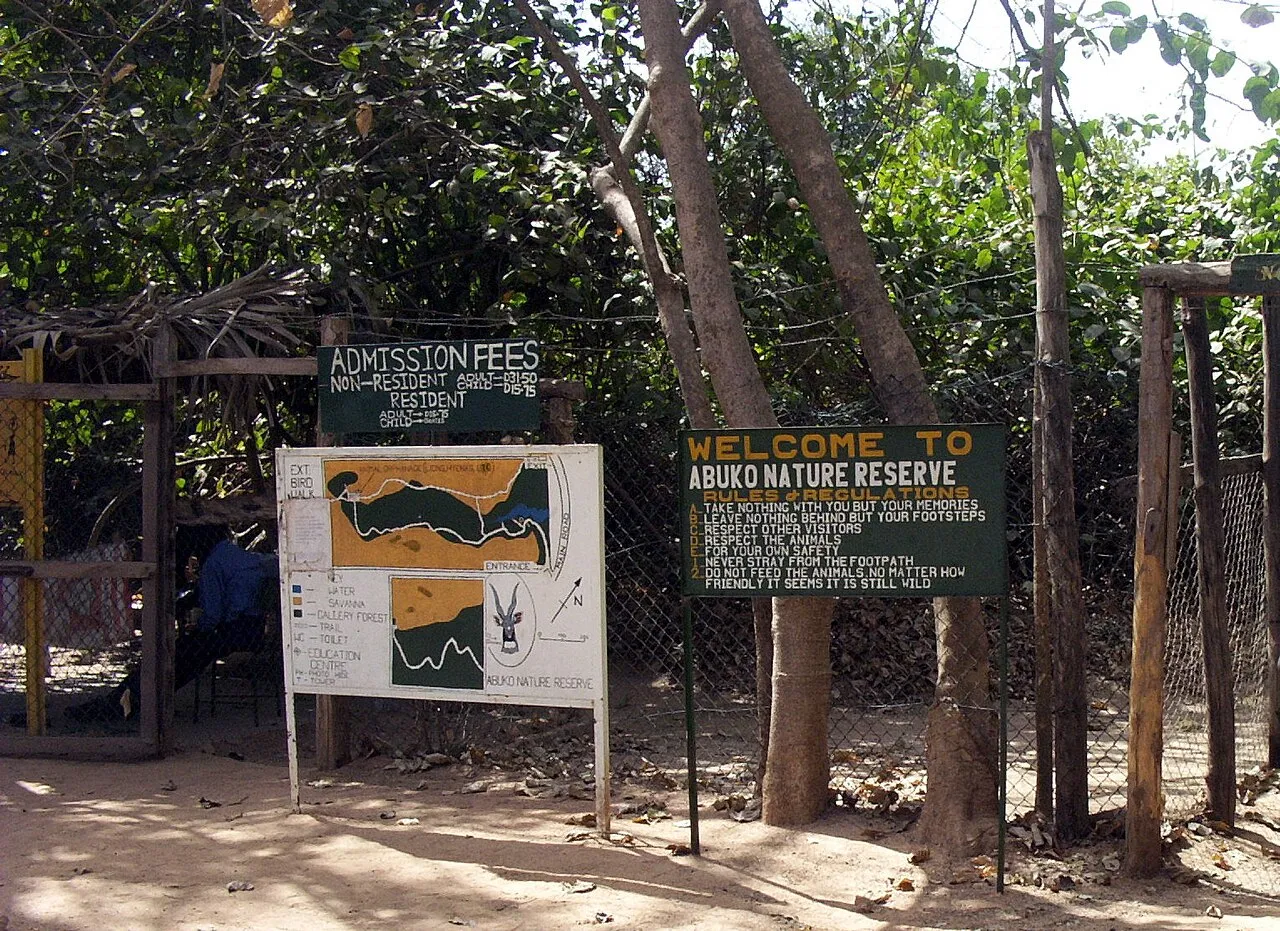
The Department of Parks and Wildlife Management manages the reserve’s animals and plants from the Darwin Field Station. It helps fund its work by charging day trippers an entrance fee. In 2009 Access Gambia put a day trip without a tour operator at around £4. With a tour operator, it said, the cost could be up to £302 for a full guided tour including hotel transfers.
For birdwatchers the best time is early morning or late afternoon, which avoids the tourist crowds that tend to arrive in the late morning or early afternoon. A walk along the trail can take a couple of hours, though there is a short cut. From the orphanage enclosures a path veers off towards the exit if you are tired. Wear thick sturdy boots, use mosquito repellent and bring refreshments if you plan to stay long. There is a kiosk for refreshments2 at the orphanage.
In 2016 TTAG said designated guides on site1 helped visitors find animals and birds on the forest trail. It added that a tip was appreciated but not mandatory.
Getting there
Abuko Nature Reserve lies south of the town of Abuko3. It is within easy reach by taxi1 from any of the main coastal holiday resorts. If you are not with a tour operator, catch a cheap bush taxi from Westfield Junction2 going to Lamin Village on the main Serekunda to Brikama road, and ask to be let off at the front entrance.
Nearby
Bijilo Forest Park is a small rainforest nature reserve on a cliff edge on the beach, within easy walking distance of the Senegambia strip. Lamin Lodge is a large tree-house style lodge on the edge of the creeks, with views over the mangrove swamps, and small boats can be hired there. Makasutu Culture Forest runs day trips with guided forest walks and dugout canoe trips along the creeks. Tanji Bird Reserve is on the coast in western Gambia1, and its 612 hectares take in dunes, lagoons, mangroves and dry woodland.