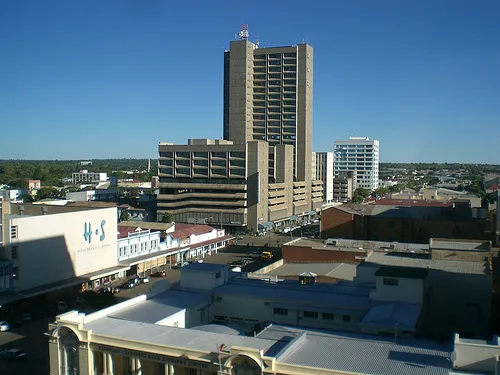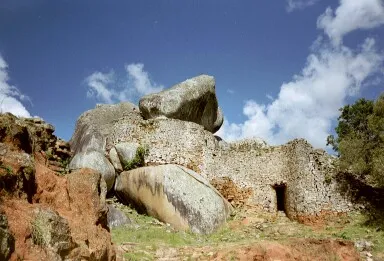
Great Zimbabwe is the largest stone structure built in precolonial Southern Africa, a dry-stone city whose ruins sit within about 20 km of the town of Masvingo1 in south-eastern Zimbabwe. Construction ran from the 11th to the 15th century, raised by ancestors of the Shona people, and the site served as the capital of a trading kingdom whose influence reached the Indian Ocean coast. The modern country took its name from this place at independence in 19802, and the soapstone Zimbabwe Bird found here appears on the national flag today. For visitors, it is one coherent site best seen as three distinct areas rather than a single ruin.
Getting oriented
The monument spans roughly 722 hectares, and its three main areas were built and used in sequence rather than all at once. The Hill Complex, on a granite outcrop, is the oldest part, occupied from the 11th to the 13th century and reached by a steep path up the rock. Below it, the Great Enclosure was occupied from the 13th to the 15th century, and the Valley Ruins, split into upper and lower sections, were occupied last, from the 14th to the 16th century2. Walking between all three in order, hill first, roughly follows the city’s own history.
Highlights
The Hill Complex contains the Eastern Enclosure and a balcony looking down over the valley below; a granite boulder here resembles the Zimbabwe Bird and is thought to have given the carvings their form. As the earliest-built and highest part of the site, it is the natural starting point and gives the clearest sense of the city’s scale from above.
The Great Enclosure is the most photographed structure, a dry-stone wall standing 11 metres high and running for about 250 metres, built without mortar from shaped granite blocks. Inside stands the Conical Tower, a solid stone cone 9 metres high and 5.5 metres across2 at its base, whose purpose is still debated; it is generally read as a symbol of royal or ritual authority rather than a functional building. The enclosure is thought to have served as the royal residence, with separate areas for public ceremony.
The Valley Ruins are lower-density clusters of house platforms and smaller walled enclosures spread across the valley floor between the hill and the Great Enclosure. They are where most of the everyday finds have come from: pottery, gold jewellery, copper ingots, and imported Chinese porcelain and Arabian coins that point to the city’s role in Indian Ocean trade. Eight soapstone Zimbabwe Birds2, representing the bateleur eagle as a protective spirit in Shona belief, were found across the site and are now split between the on-site museum and collections elsewhere.
Getting around
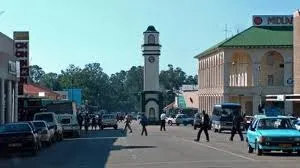
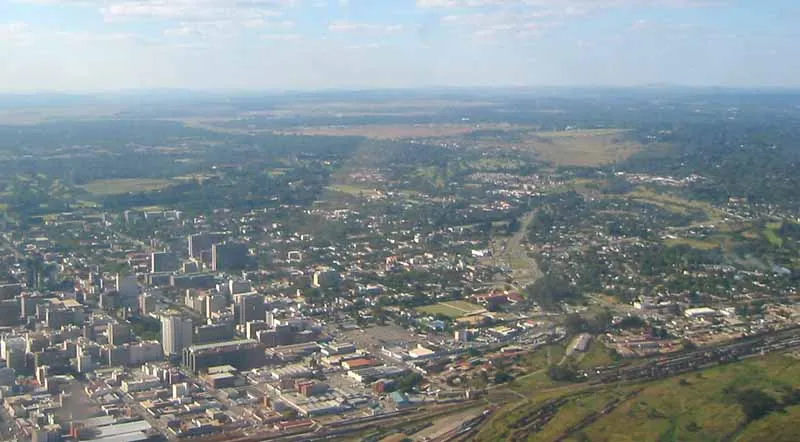
There is no scheduled commercial airport at the site itself; the facts box above has the nearest options and their distance. Most visitors arrive by road from Masvingo, the provincial town 20 km away, which itself sits 292 km south of Harare1 on a sealed road. A hire car, transfer or organised tour covers the short last stretch from Masvingo to the monument; once inside, the three areas are connected by marked paths that most visitors cover on foot over half a day to a full day.
Where to stay by area
Masvingo town is the practical base: it has the widest choice of hotels and lodges and puts you within a short drive of the ruins, with the added convenience of shops, fuel and onward transport connections to Harare or Bulawayo. A smaller number of lodges sit closer to the monument itself, nearer Lake Mutirikwe, trading Masvingo’s convenience for a quieter setting and a shorter morning drive to the gate. Either works for a one- or two-night stop built around the ruins.
Day trips
Lake Mutirikwe, a reservoir of about 90 km² formed by the Kyle Dam in 19603, lies close to Great Zimbabwe and has a recreational park on its northern shore. It is a straightforward add-on for anyone with an extra half-day, combining a change of scenery from the dry stonework with the chance to be on or near the water. Masvingo town itself, though mainly a logistics stop, is the departure point for both the ruins and the lake, and the natural place to break a longer overland trip between Harare and the south-east of the country.
_Tg7jU.webp)