Why go
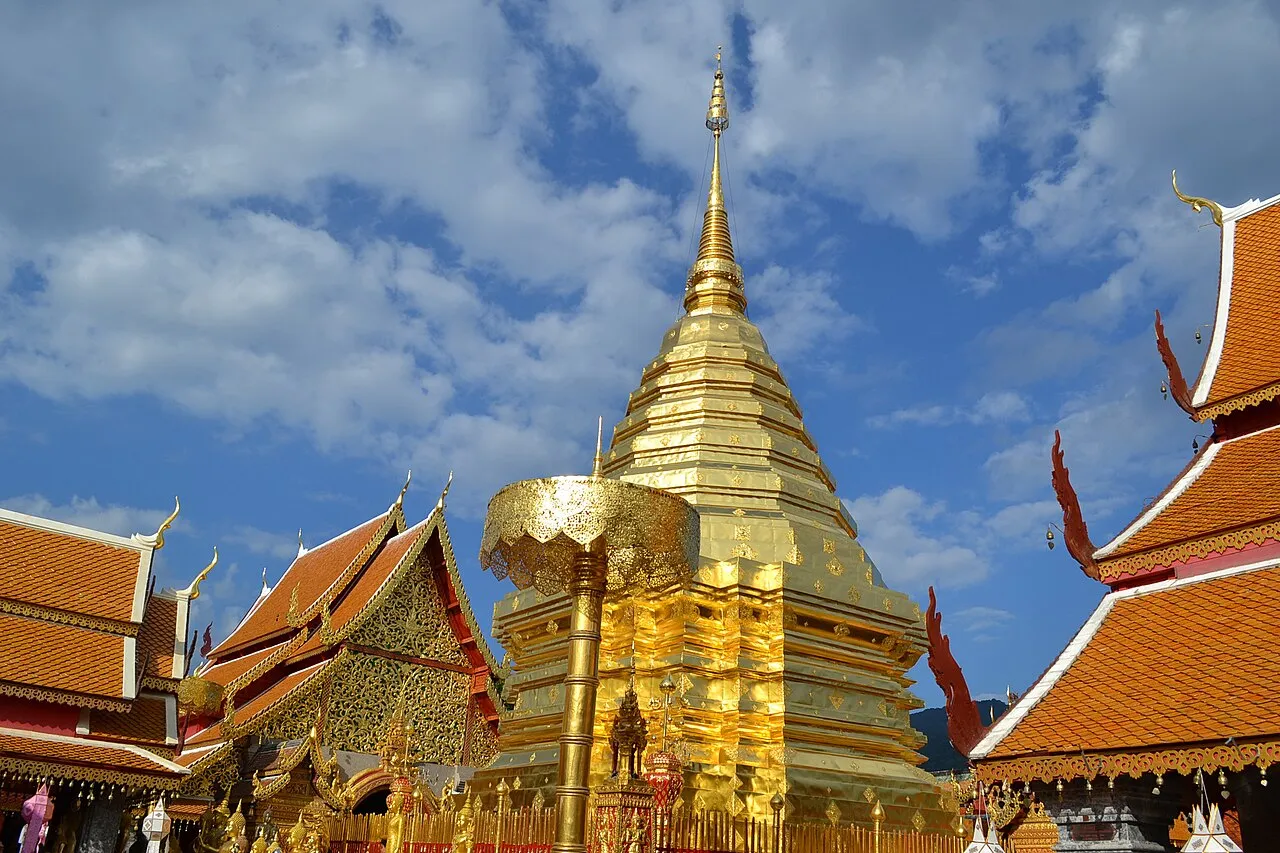
Wat Phra That Doi Suthep is the temple that defines Chiang Mai from a distance: its golden chedi catches the sun on the mountainside above the city, and on a clear day you can pick it out from the old town below. The temple sits about 15 kilometres from the city, 1,050 metres up the slopes of Doi Suthep, and by legend marks the spot where a white elephant carrying a relic of the Buddha climbed the mountain, trumpeted three times, and died — read by King Kue Na of Lan Na as a sign of where to build. The relic itself, said to be a fragment of the Buddha’s shoulder bone, was reportedly found by the monk Sumanathera and is credited with showing magical properties before the elephant ever set off. The first stupa went up in 1383, which makes this one of the oldest working temples near the city rather than a modern viewpoint dressed up as one.
It still draws crowds for that reason: up to 120,000 visitors a month climb or ride up, with the biggest numbers around Songkran and Visakha Bucha Day, when Thai Buddhists mark the Buddha’s birth, enlightenment and death with candlelit processions around the chedi. Go early morning or late afternoon for a quieter terrace and better light on the gold; midday brings tour buses and the fullest car park at the base.
Doi Suthep works as a half-day trip on its own or as the first stop before Bhubing Palace and the hill-tribe villages further up the same road, so plan the visit around how much of the mountain you want to see rather than the temple alone.
What you will see
At the centre of the complex stands the chedi itself, a gold-plated stupa about 24 metres tall on an octagonal redented base, its tiered umbrella spire a design brought north during two centuries of Burmese occupation of Lan Na. You’ll see monks and visitors alike walking slow circuits around it in quiet contemplation, a practice you’re welcome to join or simply watch from the surrounding cloister.
Around the chedi, look for a shrine built around the founding legend’s white elephant, a Ganesh statue, bells, and a model of the Emerald Buddha among the smaller pagodas that fill the grounds; a small on-site museum covers the temple’s history in more depth than a single visit usually allows, with old photographs and relics tracing the site from the 14th-century founding through the road-building era. Worshippers ring the row of bells on the way past, a habit visitors are free to copy quietly.
Past the shrines, the terrace on the mountain-facing side gives the payoff for the climb: a wide view over the Chiang Mai valley floor, hazy with distance and, in burning season, with smoke. On a genuinely clear day, usually in the cooler months, you can make out the old city’s moat and the airport beyond it; cloud or haze more often blurs the view into a soft grey-green rather than a postcard panorama, so treat the outlook as a bonus rather than the main reason to come.
Visiting: hours, admission, booking
Opening hours and the current admission are in the facts box on this page. Read that admission figure carefully: officially it is the fare for the electric tram that carries visitors up the final stretch to the temple, not a separate entrance ticket, and Thailand’s tourism authority does not list a distinct gate fee on its official page. Walking up instead — the naga staircase, 309 steps flanked their full length by two mosaic-tiled serpents and reputedly the longest such balustrade in the country — costs nothing. Travellers who can’t manage the stairs can ride the funicular railway that runs alongside it instead; the same route is wheelchair accessible via a series of steep ramps.
Dress modestly: once inside the temple grounds, visitors must be appropriately dressed and must remove their footwear before stepping onto the chedi terrace and into the shrine buildings — shoulders and knees covered is the safe standard. Sarongs are available to rent at the entrance for anyone caught out.
Getting there
The road up the mountain was built in 1935, overseen by the monk Khruba Siwichai; before that, reaching the temple meant a long climb through forest. Today a taxi, red songthaew or hired driver covers the same 15 kilometres from the old city on that paved switchback road, which makes Doi Suthep an easy half-day trip rather than an expedition. Shared red songthaews leave from set points around the old city and near Chiang Mai University once they have enough passengers, which keeps the fare down but means the return trip is less predictable than a private taxi or driver booked for a fixed time. Self-driving works too if you’d rather set your own pace, though the switchback bends are tight enough that a scooter is a poor choice for anyone unused to mountain roads; parking is at the base, by the staircase and tram station.
Nearby
Doi Suthep sits inside Doi Suthep–Pui National Park, Thailand’s 24th national park, established in 1981 and covering roughly 257 square kilometres of forest across three peaks, the tallest of which, Doi Pui, reaches 1,685 metres. The park logged around 328,659 visitors in 2019, and it’s noticeably cooler up here than in the city — typically 20 to 23°C, dropping close to 6°C on a cold winter night, so bring a layer even in the tropics. The forest itself shelters more than 2,000 plant species, over 300 bird species and, for anyone who looks closely at the undergrowth, 561 recorded butterfly species.
With more than a morning to spare, Bhubing Palace — the royal family’s winter residence, generally open to visitors when the family is not in residence — and the Mae Sa and Monthathan waterfalls sit inside the same park, on the same road up. Beyond the palace, the road continues to Doi Pui, where a Hmong hill-tribe village sells crafts and produce alongside short walking trails into the forest; it’s a reasonable extension if you’ve already committed to the mountain for the day. Wear proper shoes if you plan to walk any of the park trails — the cooler, wetter upper slopes make for muddier paths than the dry lowland city.
Back in the city, the Chiang Mai page covers the old city’s walled temples, the Nimman café district, and how to get around, all of which pair naturally with a morning spent on the mountain.