Kabwe sits on Zambia’s central plateau on the Great North Road, 100 kilometres north of Lusaka on the way to the Copperbelt. It grew up around a lead and zinc mine that ran from 1906 to 19941 and, under its old name of Broken Hill, gave up one of Africa’s most important early human fossils. The mine left the town with two lasting legacies: a skull in a London museum that Zambia wants back, and soil lead levels around the former mine and smelter that a 2019 Human Rights Watch investigation found exceeding international standards in several townships2.
Getting oriented
The town is a stop on the road, not a resort, and its sights sit within walking distance of the centre. The former mine works lie on the edge of town, in the townships nearest the old smelter — Kasanda, Makandanyama, Chowa, Mutwe Wansofu and Makululu2 — that carry the heaviest soil lead contamination.
Highlights
The Big Tree
A Cape fig with a wide canopy on the east side of Broadway, the Big Tree has been a meeting point since the town’s early days as a mining settlement and is listed among Zambia’s national monuments by the National Heritage Conservation Commission3. It is a five-minute stop rather than a destination in itself, but it is the easiest fixed landmark to arrange a day around.
The Broken Hill mine and the Kabwe skull
The mine that built the town ran for most of the twentieth century, and from 1925 to 1974, under Anglo American ownership, it was Africa’s largest lead producer. In June 1921, a Swiss miner and an African miner whose name was never recorded uncovered a fossil skull at the mine face; it was sent to the British Museum for study and today sits in London’s Natural History Museum4. Uranium-isotope dating in 2020 put it at closer to 300,000 years old1, and it is recognised as the first early human fossil found in Africa, originally named Homo rhodesiensis, a name folded into Homo heidelbergensis5 in later classifications. Zambia’s government has requested that it be returned, and the skull remains in London. The ground here carries the same lead legacy2 as the rest of the old works: a place to know the story of, not one to visit on foot.
Getting around
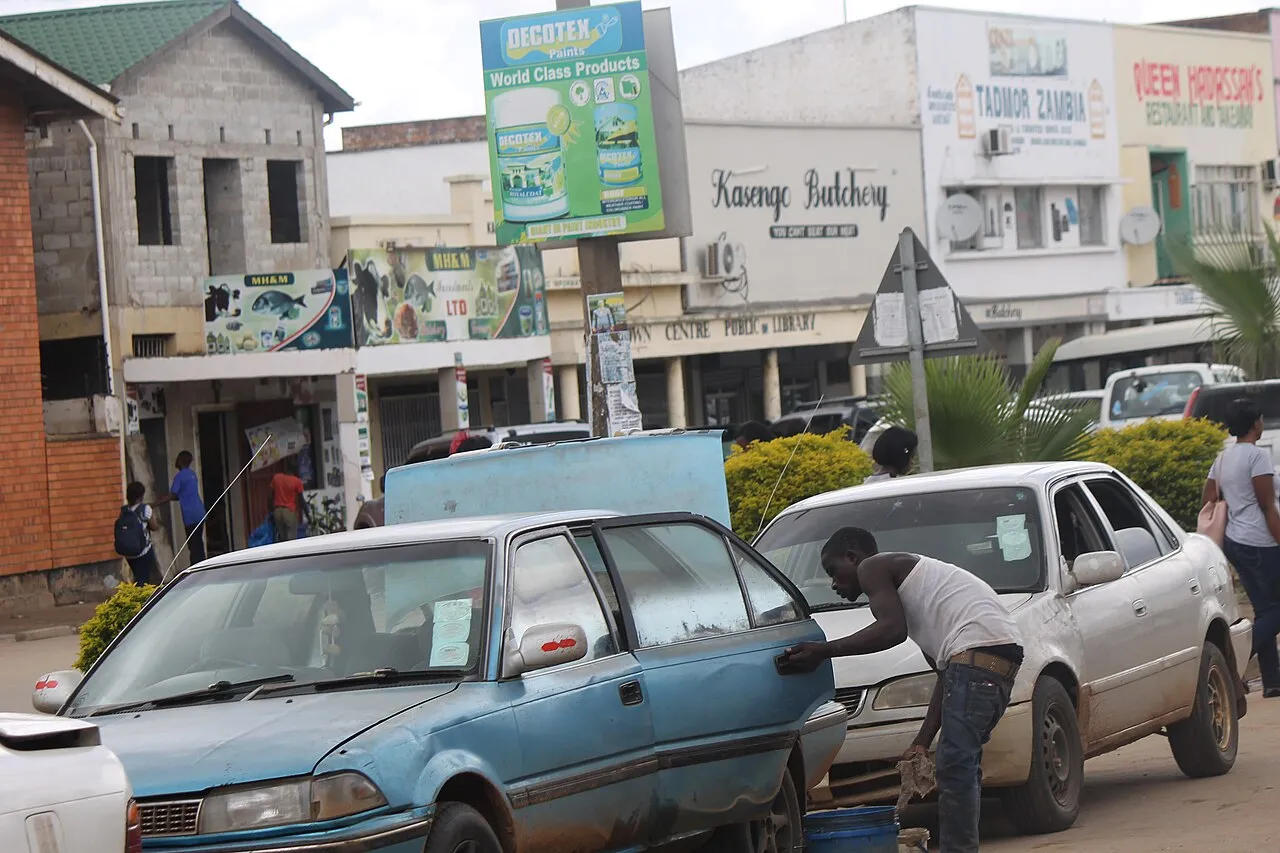
Independence Avenue is the town’s main street and becomes the Great North Road outside Kabwe6, the paved route south to Lusaka or north to the Copperbelt. Intercity coaches running between Lusaka and the Copperbelt call at Kabwe’s bus station on Independence Avenue, and blue-and-white minibuses handle trips around town; away from the main streets, roads have deteriorated into dirt tracks with bumps and holes, so a short ride can take longer than the distance suggests.
Where to stay by area
The centre, around Broadway and the bus station, suits a one-night stop on the Lusaka-Copperbelt road: everything described above is within easy reach on foot or by a short minibus ride. Lodging on the Great North Road south of town6 works for drivers who want to be back on the main route early, at the cost of a longer walk into the centre.
Day trips
Mulungushi Rock of Authority, a kopje beside the Mulungushi River about 10 km7 from Kabwe, is where Kenneth Kaunda’s nationalist movement held an October 1958 rally and, in 1960, the first conference of the party that led Zambia to independence; it continues to host political gatherings and university graduations. Further out, the Mulungushi Dam, 508 to 60 kilometres southeast of Kabwe depending on the account, was built by the mine’s own development company and opened in 19259 to power the works; its reservoir, now run by a hydropower company, has become a weekend spot for boating and fishing.