Why go
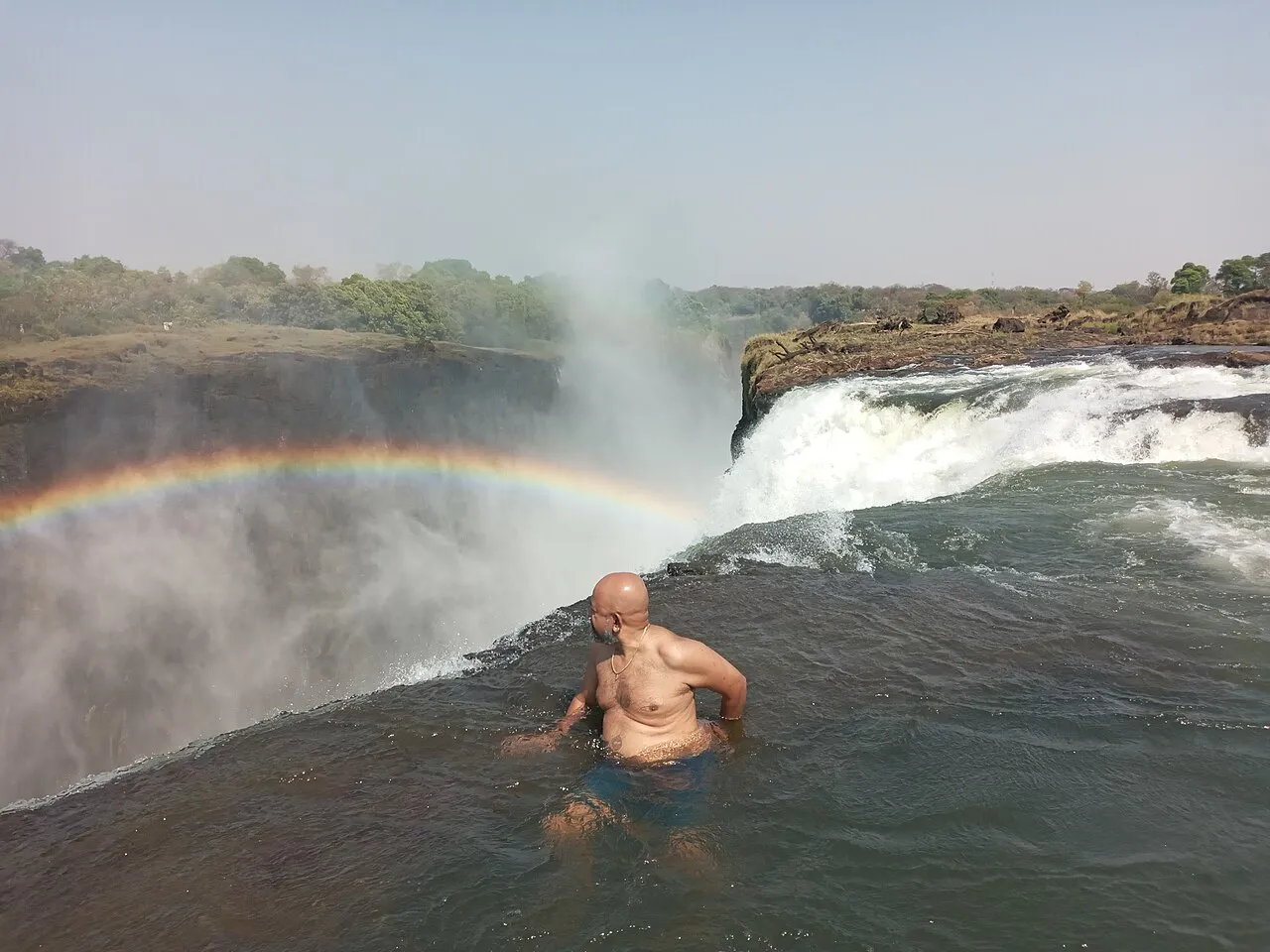
Devil’s Pool is a rock basin that forms at the very edge of Victoria Falls, one of three pools2 on Livingstone Island, which Zambia Tourism describes as the biggest island on the lip of the Falls3. The island’s operator, Green Safaris, calls the pool itself quite gentle: a natural rock lip shelters a calm, shallow space where guests can sit, float or lie back, with mist, the gorge and thundering water in the background, and you can peer over the 100-metre drop1. UNESCO gives the falls a width of about 1708 m and an average depth of 100 m4.
Swimming here is seasonal and water-level dependent. The operator opens Devil’s Pool from late August to late December, subject to water levels, as the Zambezi recedes to reveal a hidden pocket of calm1. The island itself is open 11 to 12 months of the year2.
On 16 November 1855, Kololo paddlers under Chief Sekeletu took the Scottish missionary David Livingstone to this island, and from it he caught his first glimpse of what local people called Mosi-oa-Tunya, The Smoke That Thunders. Zambia Tourism tells the same story: he landed on the biggest island3 on the lip of the falls and from there obtained his first view of them. Before it took his name, the island was locally known as Namakaba or Mbuzi Island5.
What you will see
In the pool, professionals with an intimate knowledge of the river1 guide every moment, step by step, whether you ease in for a peaceful soak or peer over the drop. Zambia Tourism lists both Livingstone Island and Devil’s Pool3 among the vantage points of the falls.
The pool forms as the Zambezi recedes1, and Zambia Tourism notes that from October parts of the falls dry up; around November and December the water thins to little rivulets running over the edge, and in some places none falls at all. The delight of that season is the view of the basalt wall3, where the size of the abyss can be fully appreciated.
Angel’s Pool runs from January to late August, when water levels are too high for Devil’s Pool; the operator calls it more of a dramatic ledge than a pool, where the river flows past your feet. Rock Pool, a basin among sculpted basalt formations, appears later in the season. The team assesses conditions each morning1 to decide which pools open that day.
Green Safaris runs the island with a zero-permanence, low-impact approach. The only permanent feature is the Livingstone Memorial Plaque, installed in 20055 for the 150th anniversary of his visit; the dining structures, seating and facilities are completely removable6. Facilities include a main dining tent seating 14 and the Loo with a View7.
Visiting: what to know before you go
All guests travel to the island by boat7, and bookings go through the official booking site. Guests choose from five daily experiences, among them a sunrise Breezer, an island lunch and a High Tea, and each boat tour includes a guided island experience, seasonal swimming and a gourmet meal. Tours are limited to 32 guests per session2, and with limited capacity the operator highly recommends booking in advance. Rates include park fees, and children pay full adult rates8.
The minimum age to visit the island is 8 years, and to swim in any pool 12 years, with every child accompanied by a responsible adult and a parent or guardian signing a waiver. The operator may refuse swimming to weak swimmers and can close swimming with no prior warning8 depending on its team’s reading of the water levels. Guests with conditions such as high blood pressure or diabetes9 are assessed before departure.
Briefings run before every trip, life jackets are mandatory during the boat journey, and swimmers are guided and briefed throughout1. Once you are on the island, your valuables, apart from cameras or phones, are locked in a metal trunk, and where it may not be possible to take your own pictures, the guides usually handle phones and cameras, at your own risk. Drones may not be flown without special written permission9 from the authorities.
Bring swimming gear, flat shoes, rafting shoes or trainers, sunblock, insect repellent and a camera, plus warm clothing in June to August, when it can be cold and windy. Non-slip water shoes are for hire at the launch site for USD 2 a pair7. Tours continue during rain9, but heavy storms may result in delays or cancellations.
If you would rather not swim, the operator says the island tour, historical interpretation and meal9 make the trip worthwhile. From 1 September to late December there is also a guided walking safari across the exposed falls, in groups of at most 6 people, lasting 1 hr 45 min and costing USD 100 plus a USD 20 National Heritage fee paid at the falls entrance. Walks in August cannot be guaranteed8.
Getting there
Your journey begins at the Livingstone Island Launch Site, 1.3 km from the main entrance of the Royal Livingstone Hotel. Arrive at least 30 minutes before your departure. The island is 10 minutes by boat2, by jet boat or speedboat7 depending on the water level.
From Livingstone town, the falls are reached by travelling south on Mosi-oa-Tunya Road for about 11 km. You can fly directly into Livingstone at Harry Mwaanga Nkumbula International Airport, and by road the town is 470 km10 from Lusaka. Victoria Falls Town lies in Zimbabwe, across the border3; for guests staying within 6 km of it, a shuttle costs USD 30 per person return7, with a minimum of 2 people per pickup.
Nearby
The rest of the Zambian side is covered on the Victoria Falls page. A path along the edge of the rainforest facing the falls gives a series of views, and from the Knife-edge Bridge3 you see the Eastern Cataract, the Main Falls and the Boiling Pot. Mosi-oa-Tunya National Park11, which runs along the Zambezi above the falls, is the only wildlife area in Zambia with white rhinos.
A portion of proceeds from every island visit supports Mukuni Village6, the community closest to the falls, and guests are welcome to visit its organic community farm. Tours from Livingstone also go to Mukuni Cultural Village and places of interest such as the Livingstone Museum10.