_1qw0PE.webp)
Why go
Khami Ruins is the second of Zimbabwe’s two great stone capitals, built after the state at Great Zimbabwe fell, around 1450. The Torwa dynasty, which ruled the Kingdom of Butua from here, moved the centre of power roughly 22 kilometres west of what is now Bulawayo after Great Zimbabwe’s decline. The dynasty’s rule ended when Changamire Dombo’s Rozvi forces conquered the site in 16831, and it was not reoccupied afterwards. UNESCO inscribed the ruins as a World Heritage Site in 19862, alongside Great Zimbabwe, recognising the same dry-stone building tradition carried into its second phase. For anyone already in Bulawayo, it is a half-day trip into a less-visited counterpart to the country’s best-known ruin.
What you will see
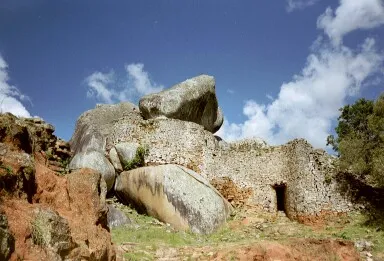
The site is organised the same way Great Zimbabwe was: a Hill Complex for the ruling elite, raised above valley areas where commoners lived and kept cattle. Khami’s builders arranged this as seven built-up platforms, encased in dry-stone retaining walls and standing 2 to 7 metres above the ground, each supporting clay huts and courtyards for the royal household. The standout structure is the Precipice Platform, whose retaining wall runs 6 metres high and 68 metres long and carries a checkerboard pattern worked into the stone along its whole length, one of the most elaborate decorative walls to survive from this building tradition. Other platforms carry herringbone and cord patterns in the same dry-stone technique, built without mortar from laminar granite blocks that had to be shaped by hand, since about 60%1 of quarried stone was unusable as it was cut.
Excavations have turned up imported Ming-dynasty Chinese porcelain, Spanish and Portuguese ceramics, Rhineland stoneware and glass beads alongside the local finds, evidence that Khami’s rulers traded gold and ivory into networks reaching the Indian Ocean coast and beyond, much as Great Zimbabwe had done a century earlier. A stone cross found on the Hill Complex is thought to have been left by a Portuguese missionary who passed through, a rare physical trace of early contact between the Torwa court and European travellers. Conservation teams worked between 2000 and 20071 to stabilise and restore the terrace walls on the Main, Cross and North platforms, so the structures you see today sit somewhere between ruin and ongoing repair.
Visiting: hours, admission, booking
The facts box above has the current opening hours and non-resident adult admission fee, both set by the National Museums and Monuments of Zimbabwe, which manages Khami along with every other national monument in the country. Buy your ticket at the gate; there is no advance online booking. Bring cash, since card payment is not reliable this far from Bulawayo’s centre, and allow one to two hours to walk the platforms at an unhurried pace. A small site museum near the entrance introduces the Torwa dynasty and some of the excavated finds before you walk out to the ruins themselves.
Getting there
Khami sits about 22 kilometres west1 of central Bulawayo, a drive of roughly half an hour on a sealed road. There is no public transport route to the site, so a hire car, taxi or organised tour from Bulawayo is the practical way in; most Bulawayo hotels can arrange a half-day transfer. The road is easy enough to self-drive in daylight, and the site is clearly signposted off the route west out of the city.
Nearby
Combine Khami with a stay in Bulawayo itself, where the Natural History Museum and the Railway Museum cover the city’s colonial and industrial history, and the Matobo Hills make a natural second day trip on the opposite side of town. For the counterpart to Khami’s story, Great Zimbabwe, the larger and earlier capital that the Torwa dynasty’s rulers traced their tradition back to, lies much further east near Masvingo, too far for the same trip but worth pairing on a longer overland route through the country.
_Tg7jU.webp)